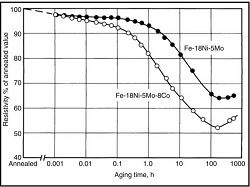
The graph shows plots of aged hardness versus aging time at 455°C (850°F) for Fe-18Ni-5Mo and Fe-18Ni-5Mo-8Co maraging steels. It has generally been observed that no incubation period accompanies the precipitation reaction in maraging steels. This behavior is evident in the graph, and it shows that significant hardening occurs after very short aging times (less than one minute).
The lack of an incubation period implies the lack of a free-energy barrier to nucleation in these alloys. Peters and Cupp attributed this lack of a free-energy barrier to two factors: the high degree of solute supersaturation, and heterogeneous nucleation on dislocations.
Cahn has shown that both of these factors can effectively reduce the free-energy barrier to nucleation. Floreen has also theorized that the good structural fit between A3B precipitates and the bcc martensitic matrix is also responsible for the lack of a free-energy barrier and the low activation energies associated with 18% Ni maraging steels.
The graph indicates that the aging response of maraging steels is influenced by aging time. Because electrical resistivity is directly related to the amount of an alloy in solid solution, the electrical resistivity is influenced by the precipitation of compounds during aging. At aging times in excess of 100 h, the electrical resistivity increases.
A similar effect on hardness can be observed in the graph. Aging times up to approximately 100 hours promote an increase in aged hardness in Fe-18Ni-5Mo-8Co and Fe-18Ni-5Mo maraging alloys, after which a decrease is observed. This phenomenon is known as austenite reversion, which accompanies the formation of equilibrium precipitates in overaged maraging steels
This information is from ASM Handbooks Online, Volume 4D, Heat Treating of Irons and Steels -> Heat Treated High-Alloy Steels -> Heat Treating of Maraging Steels -> Martensite Aging