In practice, it is difficult to separate part design from steel selection because the two steps are interdependent. In general, any steel grade that requires liquid quenching demands very conservative, careful design. In contrast, air-hardening (high-hardenability) steels tolerate some design and manufacturing aspects that could never be tolerated with a liquid quench.
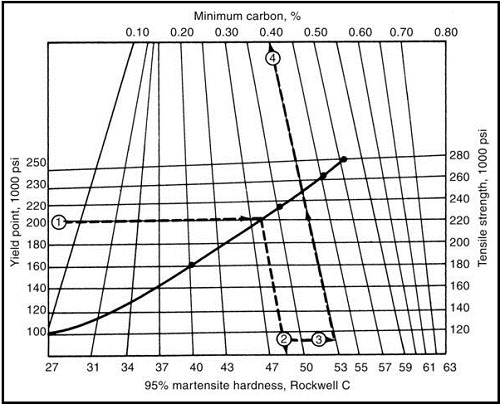
When the required yield point or tensile strength is known, the minimum carbon content and necessary hardness can be determined from this chart. In the example, a selected yield point of 200,000 psi (point 1) is equivalent to a final hardness (after temper) of 48 HRC (point 2). The recommended as-quenched hardness should be at least five points higher, or 53 HRC (point 3). A minimum carbon content of 0.40% (point 4) is recommended.Selecting the correct steel is part of the overall design process in meeting the engineering requirements of a part. The step, of course, is determining the overall engineering requirements by the designer. For a given application, requirements may include a wide variety of characteristics in terms of properties (strength, toughness, wear resistance, etc.), part geometry, dimensional tolerances, and stresses within a part.
When service requirements include loading (tension, bending, torsion, fatigue), certain hardness values can be specified for critical locations on or in the part based on the approximate correlation of steel hardness with tensile properties.
When strength or the combination of strength and toughness cannot be met by steel in the as-rolled, forged, normalized, or cold-drawn condition, then quench hardening and tempering must be used to obtain the necessary properties. Carbon steel is always lower in cost, but processing conditions may require alloying to improve hardenability.
The cost of alloying is usually justified only to develop improved strength and toughness by quenching and tempering. There are exceptions, however. The most important exceptions are low-alloy steels that require forming or welding characteristics similar to those of low-carbon structural steels but with improved mechanical properties.
When quenched and tempered steels are needed to obtain strength and toughness requirements, the first step is to determine the minimum carbon to obtain the required hardness. Hardness is a function of carbon and the amount of martensite after quenching, and the minimum carbon to provide required strength with a microstructure of 95% tempered martensite is plotted in the figure. This percentage provides an optimum combination of mechanical properties. Whichever carbon content is selected above the minima shown in the figure, the corresponding 95% minimum martensite hardness shown should be required in the as-quenched parts.
Volume 4D, Heat Treating of Irons and Steels -> Heat Treatment Problems Associated with Design and Steel Selection -> Steel Selection for Heat Treated Parts