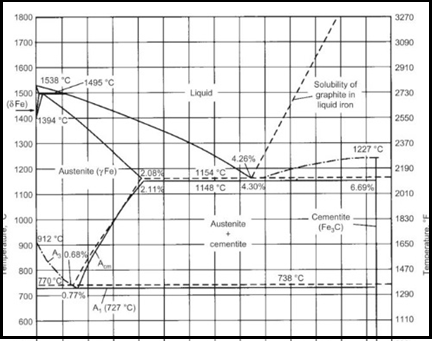
Cast irons, like steels, are iron-carbon alloys. The difference is that cast irons typically possess higher carbon levels than steels, so that cast irons can take advantage of eutectic solidification in the binary iron-carbon system, as shown in the diagram.
Cast irons often are defined as ferrous alloys that contain more than 2% carbon and 1% or more silicon. Eutectic solidification occurs with carbon content above 2%, but it also is important to note that silicon and other alloying elements may considerably change the maximum solubility of carbon in austenite (γ). Therefore, in exceptional cases, alloys with less than 2% C can solidify with a eutectic structure and therefore still belong to the family of cast irons.
Nonetheless, most commercial irons have carbon contents within the range from 2.5 to 4.0% along with other essential alloying elements, of which silicon and phosphorus are the most important.
Volume 4D, Heat Treating of Irons and Steels ->Heat Treatment of Cast Irons -> Introduction to Cast Iron Heat Treatment