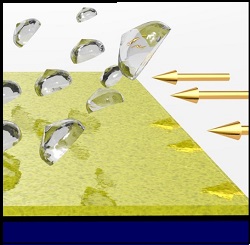
Researchers from the University of Houston report that they have developed a durable silicone polymer coating capable of repelling ice from any surface. The new material reportedly uses elastic energy localization at the interface where ice meets the material, triggering cracks at the interface that slough off the ice. Dr. Hadi Ghasemi, Bill D. Cook Assistant Professor of mechanical engineering, says it requires minimal force to cause the cracks; the flow of air over the surface of an airplane acts as a trigger, for example.
The material, which is applied as a spray, can be used on any surface, and Prof. Ghasemi says that testing showed it is not only mechanically durable and unaffected by ultraviolet rays, but also does not change the aircraft’s aerodynamic performance. Furthermore, testing indicates that it will last for more than ten years, with no need to reapply.
The coating is based on a new theory in physics called stress localization, which the UH researchers used to tune and predict the properties of new materials. The researchers reported on the theory and their results in a paper in the journal Materials Horizons. “We have developed a new physical concept and the corresponding icephobic material that shows extremely low ice adhesion while having long-term mechanical, chemical, and environmental durability,” they wrote.
Prof. Ghasemi says the findings suggest a way to take trial and error out of the search for new materials, in keeping with the movement of materials science toward a physics-driven approach.
“You put in the properties you want, and the principle will tell you what material you need to synthesize,” he says, noting that the concept can also be used to predict materials with superb antibacterial or other beneficial properties.
http://www.uh.edu/news-events/stories/2019/january-2019/01142019ghasemi-ice-phobic.php