Engineers from Carnegie Mellon University and Argonne National Laboratory report that they have discovered defects in the products of the Laser Powder Bed Fusion (LPBF) process by taking videos of the products with super-fast high-energy x-rays as they are being built.
The research shows that keyhole defects form when a certain laser power density is reached that is sufficient to boil the metal. This, in turn, reveals the critical importance of the laser focus in the additive manufacturing process, an element that has received scant attention so far, according to the research team.
During the LBPF build process, lasers scan over each layer of powder to fuse metal where it is needed, creating the finished product from the ground up. Defects can form when pockets of gas become trapped into these layers, causing imperfections that could lead to cracks or other breakdowns in the final product.
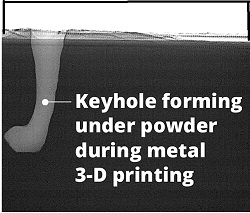
Researchers were able to watch exactly what happens as the laser moves across the metal powder bed to create each layer of the product. Under perfect conditions, the melt pool shape is shallow and semicircular, called the “conduction mode.” But during the actual printing process, the high-power laser, often moving at a low speed, can change the melt pool shape to something like a keyhole in a warded lock: round and large on top, with a narrow spike at bottom, as shown in the image. Such “keyhole mode” melting can potentially lead to defects in the final product.
See the Science article here: http://science.sciencemag.org/content/363/6429/849