Normalizing (air cooling following austenitizing) can result in a considerable improvement in tensile strength, and may be used in the production of ductile iron of ASTM type 100-70-03. The microstructure obtained by normalizing depends on the composition of the castings and the cooling rate.
The composition of the casting dictates its hardenability, that is, the relative position of the fields in the time-temperature CCT diagram. The cooling rate depends on the mass of the casting, but it also may be influenced by the temperature and movement of the surrounding air during cooling. Normalizing generally produces a homogeneous structure of fine pearlite, if the iron is not too high in silicon content and has at least a moderate manganese content (0.3 to 0.5% or higher).
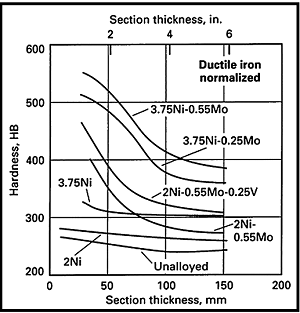
Heavier castings that require normalizing usually contain alloying elements such as nickel, molybdenum, and additional manganese, for higher hardenability to ensure the development of a fully pearlitic structure after normalizing. Lighter castings made of alloyed iron may be martensitic or may contain an acicular structure after normalizing. The influence of various nickel contents and combinations of alloying elements on hardness after normalizing different section thicknesses is shown in the graph.
To find this information, go to Handbooks Online and click on the above link. Then scroll down the list of topics on the left and click on “Normalizing Ductile Iron.”