The U.S. Department of Energy, Washington, announces that it will invest $32 million over the next four years to accelerate the design of new materials through use of supercomputers.
Seven projects will be supported, three led by teams at DOE National Laboratories and four by Universities. The teams are led by Argonne National Laboratory (ANL), Brookhaven National Laboratory (BNL) and Lawrence Livermore National Laboratory (LLNL), as well as the University of Illinois, the Pennsylvania State University, the University of Texas, and the University of Southern California.
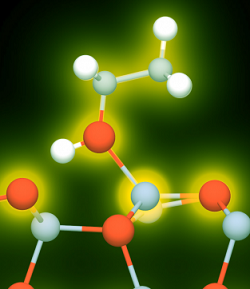
These projects will develop widely applicable open source software utilizing DOE’s current leadership class and future exascale computing facilities. The goal is to provide the software platforms and data for the design of new functional materials with a broad range of applications, including alternative and renewable energy, electronics, data storage, and materials for quantum information science.
The new awards are part of DOE’s Computational Materials Sciences (CMS) program, begun in 2015 to reflect the enormous recent growth in computing power and the increasing capability of high-performance computers to model and simulate the behavior of matter at the atomic and molecular scales.
Researchers are expected to make use of current generation petaflop supercomputers and prepare for next-generation exaflop machines scheduled for deployment in the early 2020s. Current machines include the 200-petaflop Summit computer at the Oak Ridge Leadership Computing Facility, the 11-petaflop Theta computer at the Argonne Leadership Computing Facility, and the 30-petaflop Cori machine at the National Energy Research Scientific Computing center at Lawrence Berkeley National Laboratory.
A petaflop is a million-billion floating-point operations per second. An exaflop is a billion-billion calculations.
Research will combine theory and software development with experimental validation, drawing on the resources of multiple DOE Office of Science user facilities, including the Advanced Light Source at LBNL, the Advanced Photon Source at ANL, the Spallation Neutron Source at Oak Ridge National Laboratory, the Linac Coherent Light Source at SLAC National Accelerator Facility and several of the five Nanoscale Science Research Centers across the DOE national laboratory complex.
https://www.energy.gov/articles/energy-department-invest-32-million-computer-design-materials