Zurich Instruments, Switzerland, is participating in the SuperMOOSE project, which aims to entangle two error-corrected qubits and thus lay the foundation for future quantum computers.
In this project, Zurich Instruments joins forces with two leading experimental labs at ETH Zurich and MIT, the quantum computing startup Atlantic Quantum, and leading theorists at Université de Sherbrooke and Forschungszentrum Jülich. The project is funded by the American agency IARPA under the Entangled Logical Qubits (ELQ) program.
An error-corrected logical qubit is realized by multiple physical qubits, creating redundancy of quantum information and allowing for error detection. Zurich Instruments will provide the dedicated control electronics required to operate the complex quantum devices required for such experiments. The ELQ program builds on the successful realization of logical qubits under the IARPA LogiQ program, in which Zurich Instruments has established its position as a leading system provider supporting error correction technology.
Science, industry and society have been dreaming of quantum computers for many years. These hold the promise of solving challenging computational problems that are beyond the capabilities of conventional computers. But so far, their susceptibility to errors has limited their use to a handful of extremely specific tasks.
The US research funding agency IARPA has launched multiple basic research projects aimed at entangling two logical qubits and transferring the quantum state of one logical qubit to the other. To this end, IARPA plans to invest a total of up to 40 million dollars over the next four years in two projects: SuperMOOSE, led by ETH Professor Andreas Wallraff, and MODULARIS, which is being coordinated by the University of Innsbruck with participation from the group led by ETH Professor Jonathan Home. Wallraff’s team is collaborating with researchers from MIT, Forschungszentrum Jülich, the Université de Sherbrooke in Canada and two companies, Zurich Instruments and Atlantic Quantum. The ETHZ-PSI Quantum Computing Hub at the Paul Scherrer Institute is also involved in both projects.
There are two different technologies in play in these projects. While the ETH team is using superconducting components, the Innsbruck team’s approach is based on ion traps. Details of both teams’ progress will be published in scientific journals and the success of the initiative will be evaluated at regular intervals over the four years it is scheduled to run.
Quantum computers are among the key technologies of the 21st century. Developing them, however, is a complex, time-consuming and costly process. This makes international collaboration essential. “IARPA’s decision to fund not one but two projects in which ETH Zurich is involved confirms our university’s leading position in this vital research area,” says a delighted Christian Wolfrum, Vice President for Research at ETH Zurich. “It’s now crucial that Switzerland be an associated country in Horizon Europe as soon as possible so that our researchers can also participate in the EU’s flagship quantum program.”
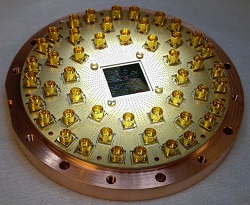
Image – Helps correct errors: supercomputing quantum chip with 17 qbits mounted in a fixture with 48 control lines. Courtesy of: Quantum Device Lab, ETH Zurich.
For more information:
Eidgenössische Technische Hochschule (ETH) Zürich
Zurich Instruments AG
https://www.zhinst.com/americas/en