North Carolina State University, Raleigh, announces that its researchers have developed a combination of steel composite foam (CMF) and epoxy resin that meet requirements for airplane wing leading edges better than the aluminum currently in widespread use.
“We call our hybrid material infused CMF,” says Afsaneh Rabiei, corresponding author of a paper on the work and a professor of mechanical and aerospace engineering at NC State. “While infused CMF is about the same weight as aluminum, it is tougher and has other characteristics that make it more appealing from the standpoint of flight performance, safety, and fuel efficiency.”
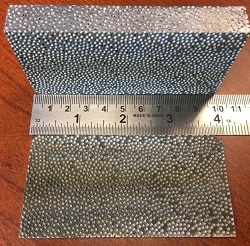
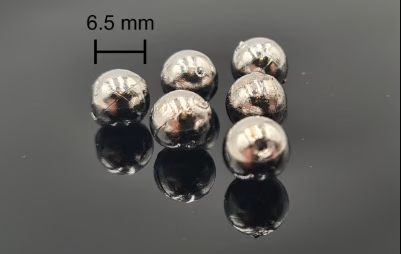
CMF consists of hollow metallic spheres embedded in a matrix of metals such as stainless steel, titanium, or aluminum. For this study, the researchers used steel-steel CMF, meaning that both the spheres and the matrix were made of steel. Previous work has found the metal foam is remarkably tough: it can withstand .50 caliber rounds, resist high temperatures, and block blast pressure from high-explosive incendiary rounds.
The infused CMF is made by immersing the CMF made of steel spheres in a steel matrix, into a liquid hydrophobic epoxy resin. Then vacuum forces pull the resin into both the hollow spheres and into much smaller pores found in the steel matrix itself. This results in about 88 percent of the CMF’s pores being filled with epoxy resin.
The researchers then tested both infused CMF and aerospace grade aluminum to see how they performed in three areas: contact angle, which determines how quickly water streams off a material; insect adhesion, or how well bug parts stick to the material; and particle wear, or how well the material stands up to erosion. All of these factors affect the performance of an aircraft wing’s leading edge.
The researchers found that infused CMF had a contact angle 130% higher than aluminum — a significant improvement. Insect adhesion is measured in two ways: by the maximum height of insect residue that builds up on a material, and by the amount of area covered by insect residue on the surface. Again, infused CMF outperformed aluminum — by 60% in regard to maximum height, and by 30% in regard to the surface area covered.
The researchers found that, while grit blast did increase surface roughness for infused CMF, it still fared better than aluminum. For example, at its worst, infused CMF still had a contact angle 50 percent higher than that of aluminum.
In other words, the infused CMF retained its properties through erosion and wear, which indicates that it would give leading-edge wing components a longer lifetime — and reduce the costs associated with maintenance and replacement.
https://newatlas.com/materials/resin-infused-composite-metal-foam-wings/