Researchers Saarland University (Saarbrücken, Germany), are studying metallic-glass alloys in experiments carried out on board the International Space Station (ISS). Working with the European Space Agency and the German Aerospace Center, in the fall of 2026, the team will investigate the properties of these alloys using hot, levitating droplets.
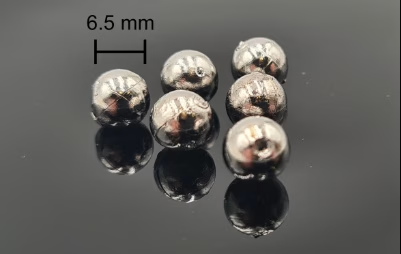
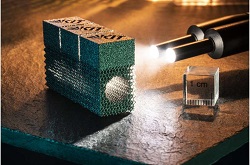
The research team led by materials scientist Ralf Busch from Saarland University will study metallic-glass beads like the ones shown here, made from a nickel-niobium-sulfur alloy. The beads will be melted on board the ISS without a crucible and studied as levitating droplets at temperatures of up to 1700°Celsius.
Metallic glasses are metals that solidify like glass. The word “glass” should not be interpreted to mean that a metallic glass is fragile. On the contrary, these alloys are stronger than steel.
“They are also elastic and at elevated temperatures can be formed like plastics, which means they can be processed using techniques such as injection molding or metal 3D printing,” says Busch. This allows metallic glasses to be shaped into complex geometries of almost any kind, a further active area of research for Busch and his team. His research group at Saarland University already holds several patents for novel, ultra-high-strength alloys with new properties.
The metallic glasses being developed in Saarbrücken are new materials whose properties can be tailored for use in engines and machinery. Examples include new components that make electric motors more energy-efficient, as well as screws and geometrically complex parts that are strong enough to withstand the extreme conditions encountered in aerospace applications.
What makes the International Space Station so valuable for the Saarbrücken materials researchers is the apparent weightlessness experienced on board. This sustained state of suspension is exactly what Ralf Busch’s research team at Saarland University needs: droplets of their new alloy that can remain stable and stationary during measurement.
The aim is to obtain new, high-precision data that will help to further improve the material. A follow-up series of ISS experiments involving other alloys is already in preparation.
Image – Metallic-glass beads like the ones shown here, made from a nickel-niobium-sulfur alloy, will be melted on board the ISS without a crucible and studied as levitating droplets at temperatures of up to 1700°Celsius. Courtesy of Lucas Ruschel.
************
For more information:
Saarland University