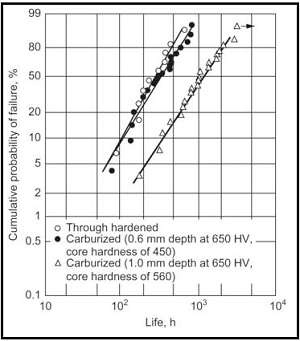
Two ways to make bearings more fatigue resistant in the presence of contaminated lubricants are to increase surface hardness of the rolling contact surface, thus minimizing damage by contamination; and to make the rolling contact surfaces more damage-tolerant, so that surface distress caused by contaminants is less likely to initiate and propagate fatigue cracks.
Carburizing and carbonitriding treatments are frequently applied to achieve superior wear and fatigue resistance of bearings operated under a lubrication environment contaminated with foreign particles. The aim of these treatments is to both increase surface hardness and optimize the amount of retained austenite and residual stress in the case layer.
The resulting microstructure limits the height and modifies (smooths) the shape of the dent lips due to contaminants. This results in lower contact stresses, and the inherent ductility of the retained austenite impedes fatigue crack propagation. Improved performance in a debris-containing environment has been demonstrated in carburized cases with higher retained austenite content compared with through-hardening grades, or cases with lower retained austenite content
For more information, click on the link below (subscription required). Then scroll down the Chapter Contents column on the left of the page, and click on “Carburizing.”
https://dl.asminternational.org/handbooks/book/9/chapter/110017/Heat-Treatment-of-Bearings