Nitrogen diffused into the component during nitriding forms two zones: a compound layer and a diffusion zone. The compound layer, or white layer, consists of iron carbonitride phases, and is very hard; it is not compatible with a rolling-bearing application and should be ground off all race and working surfaces. The diffusion zone consists of dissolved nitrogen in the matrix and nitrides (carbonitrides that precipitate in the matrix).
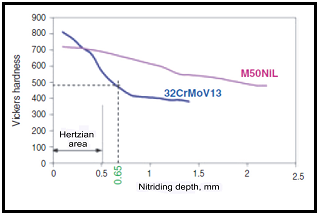
The nitrided layer has high hardness, high compressive residual stresses, and excellent rolling contact-fatigue properties in both clean and contaminated environments. A typical hardness profile compared with a hardness profile of M50NiL is shown in Fig. 41, below. The near-surface hardness is much harder than that for M50NiL, but the overall case depth is shallow.
Interstitial nitrogen dissolved in the matrix, together with the formation of nitrides and carbonitrides, induce a volumetric expansion in the near-surface region, resulting in development of a compressive residual stress field.
For more information, click on the link below (subscription required). Then scroll down the Chapter Contents column on the left of the page, and click on “Carburizing and Nitriding Practices for Specialty Steels.”
https://dl.asminternational.org/handbooks/book/9/chapter/110017/Heat-Treatment-of-Bearings