In addition to having many of the same benefits as carburizing, carbonitriding also has the added benefit of nitrogen diffused in the surface layer, which stabilizes retained austenite. Therefore, the amount of retained austenite after quenching is increased, and the solution of nitrogen in the case layer also enhances resistance to temper softening.
Carbonitriding is applied to both carburizing and through-hardening grades. Surface hardness up to 65–66 HRC can be achieved with a microstructure consisting of residual carbides/carbonitride particles and elevated retained austenite content in a matrix of tempered martensite.
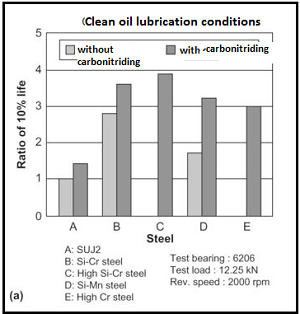
The resultant microstructure provides excellent wear resistance, resistance to surface damage, and ductility. In addition to the favorable microstructure, compressive residual stresses on the order of −25 ksi (−172 MPa) are developed in the carbonitrided case. The result is a material with improved fatigue life, particularly in contaminated and poorly lubricated environments. Fatigue life improves in clean environments, but the increase is not as significant as in contaminated environments (Fig. 43).
For more information, click on the link below (subscription required). Then scroll down the Chapter Contents column on the left of the page, and click on “Carbonitriding’
https://dl.asminternational.org/handbooks/book/9/chapter/110017/Heat-Treatment-of-Bearings