Transformation rates in quenching are of general importance to heat treating, and continuous cooling diagrams are valuable guides. Heating response has similar significance for the induction practitioner. Very rapid heating is one benefit of induction hardening, but it introduces additional considerations in choice of materials.
Using 52100 as an example, a traditional bearing process might include spheroidize annealing to facilitate machining prior to heat treatment. But the time needed for dissolution of the spheroidized structure results in sluggish transformation to austenite. Temperature can be increased beyond standard furnace practice in the induction process, but full hardening is difficult to achieve.
Fortunately, for many parts the actual volume of material to be hardened is small, and the system can be arranged to quench very rapidly. For improved heating response, a plain carbon steel might be more suitable, with no penalty for reduced hardenability. Or a grade such as 52100 still might be specified, but with the starting stock quenched and tempered instead of being spheroidized.
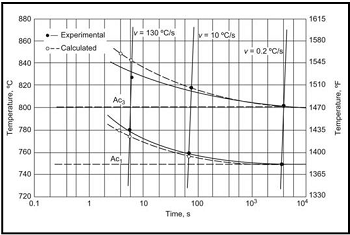
Figure 48 shows an example of a continuous heating transformation (CHT) diagram. Knowledge of the shift in response for different heating rates can assist in guiding material selection matched to a given process, or in establishing initial process parameters for a given material.
For more information, click on the link below (subscription required). Then scroll down the Chapter Contents column on the left of the page, and click on “Surface Induction Hardening.” Then scroll to Fig. 48.
https://dl.asminternational.org/handbooks/book/9/chapter/110017/Heat-Treatment-of-Bearings