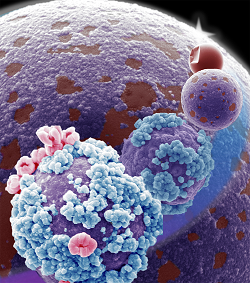
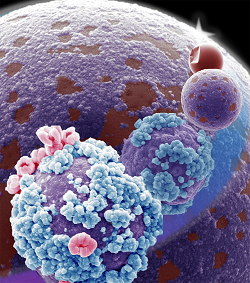
Engineers at Iowa State University, Ames, report that they have developed a way for liquid metal – and potentially solid metal – to change its surface structure in response to heat. They found that treating particles of certain liquid metal alloys with heat causes them to roughen their surfaces with tiny spheres or nanowires.
The process starts with a liquid metal alloy of gallium, indium, and tin, synthesized into particles covered with a smooth oxide shell that has been chemically stabilized. As the particles are heated, the oxide surface thickens and stiffens and begins to behave more like a solid. Eventually the surface breaks, allowing the liquid metal inside to come to the surface.
The most reactive, gallium, breaks through first. More heat brings indium to the surface. The highest heat – about 1600°F – brings out florets of tin. This movement from the under-layer to the surface allows a liquid metal particle to continuously invert its composition under thermal stimuli.
The metal particles respond to a very controlled environment: time, temperature, and oxygen levels are carefully controlled. That allows engineers to predict and program the exact surface texture of the particles. The technology could be used to fine-tune a metal’s function as a catalyst, or its ability to absorb compounds.
The technology could inspire design of ‘smart’ alloy systems that evolve the surface patterns and their composition with temperature (or analogous stimuli) for applications ranging from sensing to catalysis.
“This is not unique to these materials,” says Martin Thuo, an Iowa State assistant professor of materials science and engineering. “This is a behavior of metals in general. Other metals subject to the same treatment should do this. This is a universal property of metals.”
https://www.news.iastate.edu/news/2020/01/10/chameleonmetals