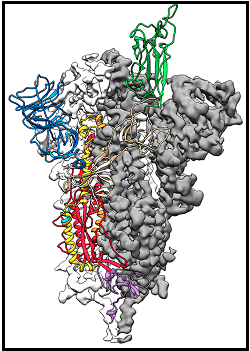
Ametek Gatan, Berwyn, Pa., reports that researchers at the University of Texas at Austin and the National Institutes of Health created the first 3D atomic-scale map of the 2019 novel coronavirus. The researchers used Ametek Gatan’s K3 camera to map a part of the virus called the spike protein, which penetrates host cells, allowing the virus to replicate. This breakthrough will allow for the rapid development of vaccines, therapeutic antibodies, and other medical countermeasures.
Photo caption from the University of Texas at Austin website:
This is a 3D atomic scale map, or molecular structure, of the 2019-nCoV spike protein. The protein takes on two different shapes, called conformations—one before it infects a host cell, and another during infection. This structure represents the protein before it infects a cell, called the prefusion conformation. Credit: Jason McLellan/Univ. of Texas at Austin.
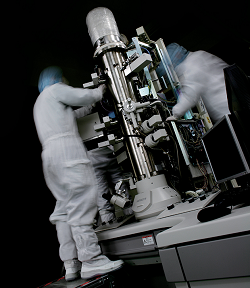
“Through single-particle cryo-electron microscopy, the researchers determined the atomic structure of the spikes,” states Christopher Booth, Director of Life Science for Ametek Gatan. “This helps explain the virus’s resistance to antibodies that disable similar illnesses. The K3 camera was the key detector used to determine the native structure in record time.”
“The K3 camera not only gave us great images that provided the atomic-resolution structure, but also it prevented data collection from becoming a bottleneck, ultimately letting our team concentrate on getting the structure as quickly as possible,” said Jason McLellan, University of Texas at Austin Associate Professor and lead researcher on the project.
Ametek Gatan’s technology is again at the forefront of groundbreaking discoveries to understand virus transmission and disease outbreaks. In 2016, Gatan’s K2 Summit camera, the predecessor to the K3, was the key detector used to develop the first three-dimensional structure of the Zika virus, which ultimately helped researchers better understand the illness and potential treatments.
This research was published in the March 13 issue of Science.
More information is available from University of Texas at Austin’s story here.