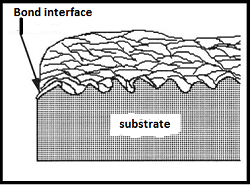
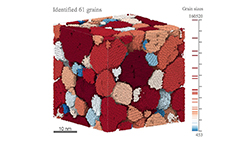
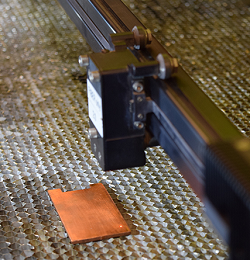
Mechanical interlocking, as illustrated above, has been viewed historically as the main mechanism of thermal spray coating adhesion. Mechanical interlocking can play a part in coating adhesion and cohesion when the surfaces being coated have features that allow molten material to flow into and fill negative relief, or where the part has negative relief, as with shafts.
In this case, the bond between the impacting particles and the surface is established largely through the impact of particles that flow and solidify around the substrate surface asperities. Substrate asperities with negative relief can be formed prior to coating by grit blasting and other mechanical surface preparation techniques, or by process-induced irregularities on the actual coating surface.
This information is from ASM Handbooks Online, Vol. 5A: Thermal Spray Technology, Coating Structures, Properties, and Materials. To find this information (subscription required), click on the link below and scroll down to Figure 10.
https://dl.asminternational.org/handbooks/book/12/chapter/132400/ Thermal Spray Coating Properties