Wire and rod feeders are simple mechanical devices consisting of electrical or air-driven motors, drive rolls, and associated speed controls. Wires and rods must be fed continuously and uniformly into the flame or arc.
The injection point of the wire/rod and feed rate are extremely important in controlling the coating quality. Uniformity of feed depends on motor drives having sufficient torque to overcome friction within the system, and in the case of wires, from the wire spools.
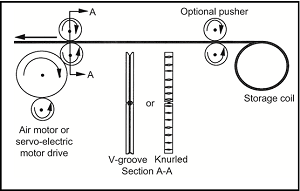
Drive roll design is another important aspect of uniform feed. Drive rolls must grip the wire/rod sufficiently to prevent slipping, while not deforming the wire or crushing the rod. Drive rolls vary according to the wire properties. Rolls are usually made from metal or fiber-reinforced phenolic. Phenolic rolls are used for ceramic rods, whereas metal rolls are used for wires. Metal rolls can be knurled for hard wires or grooved for softer wires; many variations exist. Figure 1 illustrates two concepts: V-groove and knurled.