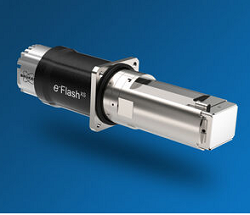
Bruker, Berlin, introduces the e-Flash XS, a new electron backscatter diffraction detector which, for the first time, enables the characterization of the microstructure of crystalline materials in tabletop and other small, entry-level scanning electron microscopes. Due to its innovative, patent-pending design, the e-Flash XS is the smallest and lightest EBSD detector currently available, yet with excellent performance. This makes it ideal for routine EBSD analysis in applications that do not require the use of high-end field emission SEMs (FE-SEM).
Designed for maximum reliability, ease of use, and EBSD pattern quality, the e-Flash XS is powered by a state-of-the-art CMOS camera with 720×540 pixels native resolution, and the capability to use it in binning modes from 2×2 up to 6×6 pixels. Coupled with an innovative optical system for maximum light transmission and a high-performance, user-replaceable phosphor screen, the camera can acquire patterns at a speed of up to 525 frames/second even at moderate electron probe currents.
Its USB3.0 interface for power supply and data transfer makes e-Flash XS a truly plug-and-play instrument. When not in use, the in-SEM portion of the EBSD detector can easily be removed by the operator for external storage to eliminate any risk of the SEM sample stage colliding with the detector.
The new e-Flash XS EBSD detector is offered in combination with a specifically designed XFlash EDS detector, both fully integrated under Bruker’s ESPRIT 2 software suite, to create the new Quantax ED-XS, a very powerful and affordable EDS and EBSD combination package for materials characterization in entry level SEMs.