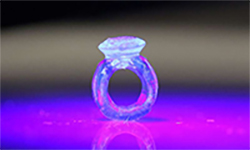
Researchers at Lawrence Livermore National Laboratory (LLNL) have adapted a new class of materials for their groundbreaking volumetric 3D-printing method that produces objects nearly instantly, expanding the range of material properties achievable with the technique.
The class of materials adapted for volumetric 3D printing is called thiol-ene resins, and they can be used with LLNL’s volumetric additive manufacturing (VAM) techniques, including computed axial lithography (CAL), which produces objects by projecting beams of 3D-patterned light into a vial of resin. The vial spins as the light cures the liquid resin into a solid at the desired points in the volume, and the uncured resin is drained, leaving the 3D object behind in a matter of seconds.
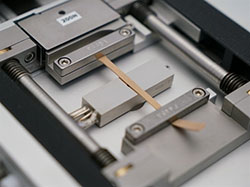
Previously, researchers worked with acrylate‐based resins that produced brittle and easily breakable objects using the CAL process. However, the new resin chemistry, created through the careful balancing of three different types of molecules, is more versatile and provides researchers with a flexible design space and a wider range of mechanical performance. With thiol-ene resins, researchers were able to build tough and strong, as well as stretchable and flexible, objects, using a custom VAM printer at LLNL.
Researchers also demonstrated the first example of a method for designing the 3D energy dose delivered into the resin to predict and measure it, successfully printing 3D structures in the thiol‐ene resin through tomographic volumetric additive manufacturing. The demonstration creates a common reference for controlled 3D fabrication and for comparing resin systems.
By studying how the resin behaves at different light dosages, researchers added they aim to improve the agreement between computational models and experiments and apply photochemical behavior to the computed tomography reconstructions that produce the 3D models used to build objects.
For more information: