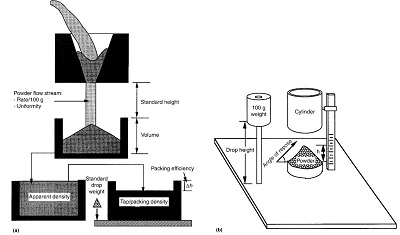
Apparent density and flowability can be measured quickly and inexpensively. Such tests are illustrated in the figure, which include a modified flow test that measures powder flow through a metering orifice as a function of time. Powder that fails to flow through the orifice signifies poor flowability.
The angle of repose or slope of the mound of powder formed by powder dropping from a specified height through a flow orifice can also be used to assess relative flowability. Poor flowability would be indicated by steep slopes of the powder pile, while free-flowing powders would have little slope. High angles of repose alone would not exclude a powder from use, although caution in feeding and handling would be suggested.
Density is a rather loosely used term in the thermal spray industry. Density is variously used to define the absence of porosity, the specific gravity of a material, and the apparent density of powder.
Apparent density is the specific gravity of a powder, which includes all the spaces between particles and the pores within the powder particles themselves. Apparent density is related to powder packing density.
As an example, wrought or forged steel may have a density of 7.8 g/cm3, whereas powdered steel may only be 3.1 to 4.7 g/cm3 because of poor particle packing.
Apparent density affects two important factors in spraying: feed rate and trajectory, for a fixed set of input parameters. The apparent density of a bulk powder is controlled largely by the particle size, size distribution, and morphology. In this sense, as apparent density changes, so does feed rate, particularly with volumetric feeders. Repeatability in a volumetric feeder, at a given feed rate, is determined by the constancy of the apparent density of the powder.
Image – Powder flowability measurements. (a) Hall flowability test. (b) Powder and angle of repose.
This information is from ASM Handbooks Online, Vol. 5A: Thermal Spray Technology, Coating Structures, Properties, and Materials. To find this information (subscription required), click on the link below and scroll down to Figure 7.
https://dl.asminternational.org/handbooks/book/12/chapter/132769/Process-Control-and-Control-Equipment#1531012