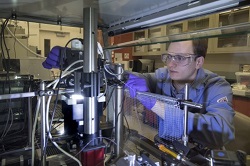
A team from the U.S. Department of Energy’s (DOE) Brookhaven National Laboratory (Upton, NY), Yale University (New Haven, CT), and University of Pennsylvania (Philadelphia, PA), built a first-of-its-kind automated electrospray deposition tool for depositing films with finely controlled blend compositions made of up to three components onto single samples.
Blending is a powerful strategy for improving the performance of electronics, coatings, separation membranes, and other functional materials. For example, high-efficiency solar cells and light-emitting diodes have been produced by optimizing mixtures of organic and inorganic components.
Combining an electrospray deposition tool with the structural characterization technique of x-ray scattering helps overcome limitations in finding optimal blend compositions that produce desired properties, a traditionally time-consuming and inconsistent process.
The new platform reduces the time to explore complex compositional dependencies of blended material systems from months or weeks to a few days, which could significantly accelerate material development.
Currently, scientists synthesize and characterize a large number of individual samples with different compositions one at a time, eventually compiling enough data to create a compositional library. An alternative approach is to synthesize a single sample with a compositional gradient so that all possible compositions can be explored at once.
Existing combinatorial methods for rapidly exploring compositions have been limited in terms of the types of compatible materials, the size of compositional increments, or number of blendable components (often only two).
Solutions of each component are loaded into syringe pumps, mixed according to a programmable recipe and sprayed as tiny electrically charged droplets onto the surface of a heated base substrate material. By programming the flow rates of the pumps as a stage underneath the substrate changes position, users can obtain continuous gradients in composition.
“We constructed a morphology diagram with more than 200 measurements on a single sample, which is like making 200 samples the conventional way,” said first author Kristof Toth, a PhD student in the Department of Chemical and Environmental Engineering at Yale University. This diagram mapped how the morphologies, or shapes, of the blended polymer system changed along a compositional gradient of 0 to 100 percent. “Our approach not only reduces sample preparation time but also sample-to-sample error.”
The team focused on a self-assembling polymer system for their demonstration. The platform can be used to explore blends of a variety of materials such as polymers, nanoparticles, and small molecules. Users can study the effects of different substrate materials, film thicknesses, x-ray beam focal spot sizes, and other processing and characterization conditions.
Their platform and demonstration are described in a paper published in RSC Advances, a journal of the Royal Society of Chemistry (RSC).
Image – Yale University PhD student Kristof Toth with the electrospray deposition tool he designed, built, and validated in collaboration with staff scientist Gregory Doerk of Brookhaven Lab’s Center for Functional Nanomaterials allowing users to blend multiple components — such as polymers, nanoparticles, and small molecules — over a range of compositions in a single sample.
For more information:
Brookhaven National Laboratory – U.S. Department of Energy’s Office of Science
https://energy.gov/science
University of Pennsylvania
https://www.upenn.edu/
Yale University
https://www.yale.edu/