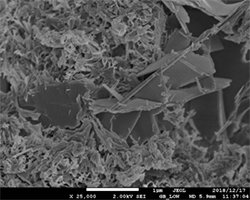
A rare mineral that has allowed Roman concrete marine barriers to survive for more than 2000 years has been found in the thick concrete walls of a decommissioned nuclear power plant in Japan. The formation of aluminous tobermorite increased the strength of the walls more than three times their design strength, Nagoya University researchers and colleagues report in the journal Materials and Design. The finding could help scientists develop stronger and more eco-friendly concrete.
Research has shown that Roman concrete used in the construction of marine barriers has managed to survive for more than two millennia because seawater dissolves volcanic ash in the mixture, leading to the formation of aluminous tobermorite. Since aluminous tobermorite is a crystal, it makes the concrete more chemically stable and stronger. It is very difficult to incorporate aluminous tobermorite directly into modern-day concrete. Scientists have generated the mineral in the lab, but it requires very high temperatures above 70°C.
Nagoya University researchers found that aluminous tobermorite formed in a nuclear reactor’s concrete walls when temperatures of 40-55°C were maintained for 16.5 years. In-depth analyses showed that the reactor’s very thick walls were able to retain moisture. Minerals used to make the concrete reacted in the presence of this water, increasing the availability of silicon and aluminum ions and the alkali content of the wall. This ultimately led to the formation of aluminous tobermorite.
For more information: Nagoya University