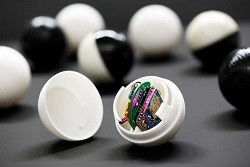
Rsearchers at the Phoenix project at Eindhoven University of Technology, Netherlands, developed a swarm of sensor nodes to explore unknown environments that are difficult for humans to access, like underground liquid-filled environments such as deep oil wells or water distribution systems. Even with modern cutting-edge technologies, it is difficult to map these areas. Ph.D. candidate Gönenç Berkol worked on ultrasound communication between these nodes, an ingenious way to map the distance and location without the use of GPS.
The sensor nodes are small balls with wires and chips inside. They flow through pipes filled with liquid to detect obstructions and leaks, or to map a pipeline network. The balls are released manually into the liquid at the beginning of the pipeline system. They then float passively with the flow until they come out and are extracted for researchers to read their data. The balls perform measurements for parameters of interest along the way, which they store internally.
To reconstruct a topological map of the environment explored by the sensor nodes, the nodes need to be localized during their movement inside the environment. GPS does not function in these liquid-filled underground environments. Berkol says, “While floating inside, the nodes must work completely autonomously as there is no contact possible with the base station. Therefore, communication among the nodes and tracking their mutual distance is a crucial task. We took advantage of the liquid environment, by using ultrasound signals to communicate.”
Distance measurements between the nodes is very complex, even with ultrasound. Operating in an enclosed volume of water, the balls collide with the pipe walls and each other, and the pipeline system branches off periodically. This all influences echoes detected via ultrasound. Synchronizing these miniaturized—thus resource-limited—sensor nodes is also challenging.
To alleviate these problems, Berkol’s Ph.D. focused on the system and hardware design of the swarm of nodes. He developed Frequency-Division Duplexing (FDD) and Frequency Modulated Continuous Wave (FMCW)-based ultrasound rangefinder methods. With this approach, the nodes use two different ultrasound transceivers tuned for isolated frequency bands during their exploration so they can separate echoes of other nodes from their own.
These FDD-FMCW based rangefinder systems address the challenges related to collision and multipath phenomena without the need of a global synchronization among the elements of the swarm.
Berkol designed, implemented, and experimentally characterized three chips: an ultrasound transceiver with state-of-the-art sensitivity and energy-per-bit, an ultra-low-power receiver, operating with 23.6nW of total power consumption while achieving the best Figure-of-Merit, and an energy-efficient ultrasound transmitter saving more than 30% energy on the large capacitance of the ultrasonic transducers. Combining these three chips, Berkol demonstrated experimentally that the ultrasound rangefinder systems can work together.
Image – Courtesy of Bart van Overbeeke.
For more information:
Eindhoven University of Technology
https://www.tue.nl/en/