Australian researchers have used plasma to make a material that could replace a scarce element used in solar cells, touch screens, and a number of other high-tech manufacturing areas.
In order to work, solar cells and phone and tablet screens need to contain a material that is transparent and can conduct electricity. The material in screen dimmers in cars and smart windows also needs to be electrochromic – that is, able to change color or transparency depending on an externally applied voltage. Until now, the primary substance for the job has been indium tin oxide or ITO. As the name suggests, this substance is made of indium, tin, and oxygen – and indium is a scarce resource.
“A very small amount of it is available,” says Dr. Behnam Akhavan, a senior lecturer in engineering at the University of Sydney. Demand is growing for indium because of the increasing production of touchscreen devices but, even though only tiny amounts are needed, there are fears supply can’t keep up.
Materials scientists have been looking for alternatives to ITO that are transparent, conductive, and electrochromic. Two years ago, Akhavan’s team created a material that ticked all of these boxes, consisting of four very thin layers of tungsten and silver on glass. They’ve now been able to refine it down to three layers, simplifying production. And the whole thing has been made using plasma.
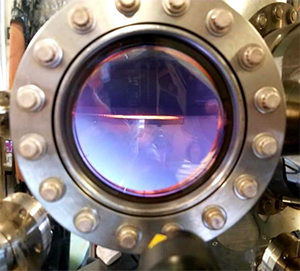
The team used a sputtering technique, known as high power impulse magnetron sputtering (HiPIMS), to create nanometer-sized coats of atoms on surfaces.
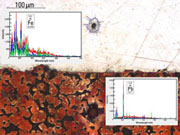
In this case, the researchers covered glass with a deposit deposited 30 nanometres of tungsten oxide, followed by 10 nanometres of pure silver and then another 50 nanometres of a “nanocomposite” of tungsten oxide and silver (nanoparticles of silver mixed into tungsten oxide). The result was a clear 90-nanometer-thick coat on the glass (or about a tenth of the size of a small bacterium) that is both conductive and electrochromic.
Akhavan says an immediate use of the technology is as an anti-reflection coating for mirrors. It could also be used in smart windows, which change their transparency to prevent the in-flow of sunlight. Touchscreens could be another potential avenue for the material – although, as these devices usually don’t need to be electrochromic, Akhavan suggests that tungsten could be swapped out for more abundant titanium. Another advantage of the technique is that it’s effectively waste-free.
A paper describing the material is published in Solar Energy Materials and Solar Cells.
For more information: The University of Sydney