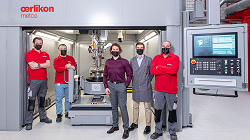
Oerlikon Metco, Wohlen, Switzerland, has built a unique laser center of competence that gives customers access to laser cladding. Laser cladding results in high-quality deposits with a metallurgical bond to the substrate.
It’s capable of multiple processes, including additive manufacturing. This opens up completely new possibilities for large parts, such as those produced by suppliers in the automotive and aerospace industries.” At the heart of the Laser Competence Center is a new, high-precision 7-axis gantry system that enables a variety of process options. It has been specially modified by Oerlikon Metco and equipped with, among other things, a specially developed tilting turntable.
Laser cladding makes it possible to build 3D structures layer-by-layer directly on the surface of components and thus change their design. Therefore, laser cladding is also included in the additive manufacturing processes of Directed Energy Deposition (DED) or Laser Metal Deposition (LMD). With Laser Cladding, additive structures can be built on the free-form surface of existing components, and thus even extremely large components for the aerospace industry can be built and/or repaired.
EHLA (Extreme High-Speed Laser Application) is achieved with high coating deposition and high application efficiency of 90%. This results in very thin layers with low surface roughness and excellent properties, positioning EHLA as a serious alternative to processes such as thermal spraying or hard chromium plating to produce, for example, wear and corrosion protective deposits on brake discs and hydraulic piston rods.
Another application of laser cladding is wire coating, in which the feedstock metal is consumed completely producing coatings with 100% deposition efficiency. This is not only economically interesting but also a promising alternative for industries where processing with noxious powders is restricted. Recent developments also open up new horizons for additive applications and the construction of highly precise 3D geometries with excellent process control.
Read further here.