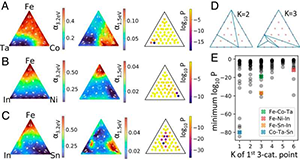
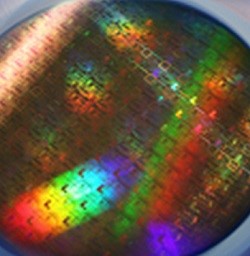
Coupling computer automation with an ink-jet printer originally used to print T-shirt designs, researchers at Caltech and Google have developed a high-throughput method of identifying novel materials with interesting properties. In a trial run of the process, they screened hundreds of thousands of possible new materials and discovered one made from cobalt, tantalum, and tin that has tunable transparency and acts as a good catalyst for chemical reactions while remaining stable in strong acid electrolytes.
The effort, described in a scientific article published in Proceedings of the National Academy of Sciences (PNAS), was led by John Gregoire and Joel Haber of Caltech, and Lusann Yang of Google. It builds on research conducted at the Joint Center for Artificial Photosynthesis (JCAP), a Department of Energy (DOE) Energy Innovation Hub at Caltech, and continues with JCAP’s successor, the Liquid Sunlight Alliance (LiSA), a DOE-funded effort that aims to streamline the complicated steps needed to convert sunlight into fuels, to make that process more efficient.
Creating new materials is not as simple as dropping a few different elements into a test tube and shaking it up to see what happens. You need the elements that you combine to bond with each other at the atomic level to create something new and different rather than just a heterogeneous mixture of ingredients. With a nearly infinite number of possible combinations of the various squares on the periodic table, the challenge is knowing which combinations will yield such a material.
When combining a small number of individual elements, materials scientists can often make predictions about what properties a new material might have based on its constituent parts. However, that process quickly becomes untenable when more complicated mixtures are made.
To broach the three-or-more-metal-oxide frontier, Gregoire’s group drew on a decade’s worth of work by JCAP. There, researchers have developed methods to create 100,000 materials per day. One such material—discovered in this study—was produced by using repurposed ink-jet printers to “print” new materials onto glass sheets. Each combination of elements was printed as a line with a gradation of the ratio between its constituents and then oxidized at high temperature.
Each of those materials was then scanned and imaged at Caltech using a hyperspectral imaging technique co-developed with Google that can quickly capture information about the material by recording how much light it absorbs at nine different wavelengths. In all, the Caltech team created 376,752 three-metal-oxide combinations based on 10 metal elements and produced samples of each individual combination 10 different times to detect and weed out any flaws in the synthesis process.
Though imperfect, the process creates three-metal materials about 1,000 times faster than traditional techniques such as vapor deposition, in which the new material is coated onto a substrate by condensing it from a vapor.
Google computer engineers then created algorithms to process the hyperspectral images and searched for specific compositions whose optical properties can only be explained by chemical interactions among the three metal elements.
To validate their findings, Gregoire’s team at Caltech recreated the materials flagged as “interesting” using physical vapor deposition and analyzed them using X-ray diffraction, a slower but more thorough process than hyperspectral imaging. This type of validation revealed that the automated high-throughput process was more adept at spotting new materials than a thorough analysis of the hyperspectral data by a human scientist.
The PNAS paper is titled “Discovery of complex oxides via automated experiments and data Science.”
For more information: Proceedings of the National Academy of Sciences