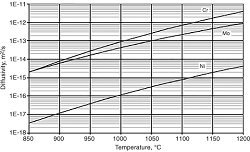
Powder metallurgy steels differ from wrought steels in the degree of inhomogeneity Alloying additions discussed previously typically are added by blending powders (admixed) of the alloying elements with iron powder. The most important reason alloying is carried out in this manner, rather than melting elements together to produce the powder (prealloyed) is to produce a soft powder mixture that can be easily compacted.
It is possible that a given PM steel part could have one of four different powders as its starting material, which affects steel properties and heat treatment. The powder types are:
Admixed—Elemental or master alloy powders are added to a base iron powder This method is used widely and has the lowest cost.
Diffusion alloyed—Alloying elements are diffusion bonded to the base iron powder particles such that the core iron retains its high compressibility. Segregation of the powder during handling is essentially eliminated, but the powder still produces a very inhomogeneous microstructure.
Prealloyed—All alloying elements except carbon are added to the melt, which is atomized to produce the powder. The sintered powder has homogeneous microstructures and compositions.
Hybrid alloys—Molybdenum is one alloying element that can be in solution in iron and still be very compressible. Prealloyed or diffusion alloyed powders of molybdenum in iron have master alloy additions to create a series of hybrid alloy steel powders.
For more information, click on the link below (subscription required). Then scroll to Figure 20.
Joseph W. Newkirk, Heat Treatment of Powder Metallurgy Steels, Heat Treating of Irons and Steels, Vol 4D, ASM Handbook, Edited By Jon L. Dossett, George E. Totten, ASM International, 2014, p 253-273, https://doi.org/10.31399/asm.hb.v04d.9781627081689.