The as-quenched properties of powder metallurgy steels depend on the cooling medium and the steel’s hardenability. Quenching in water, salt, brine, and water-based polymer solutions improves the rate of heat transfer, leading to a faster quench. However, in many cases, it accelerates corrosion due to the residual quenchant trapped in surface pores.
Oil quenching, although less severe than cooling in water or brine, is favored due to minimized distortion and cracking. Control of oil temperature is a must to achieve consistent results from load to load. A fast oil (9 to 11 s in the magnetic quenchometer test) improves heat transfer characteristics, and, therefore, is recommended.
Powder metallurgy parts absorb 2 to 3% oil (by weight), which causes problems during post quench treatment. If the oil is not completely removed, it results in heavy smoke during the tempering operation. This not only leads to health hazards but also poses safety concerns due to the large amount of oil in the tempering furnace. Also, the much higher amount of drag out of the oil must be considered during processing.
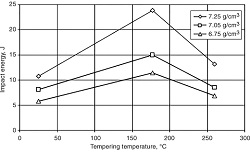
For more information, click on the link below (subscription required). Then scroll to Figure 23.
Joseph W. Newkirk, Heat Treatment of Powder Metallurgy Steels, Heat Treating of Irons and Steels, Vol 4D, ASM Handbook, Edited By Jon L. Dossett, George E. Totten, ASM International, 2014, p 253-273, https://doi.org/10.31399/asm.hb.v04d.9781627081689