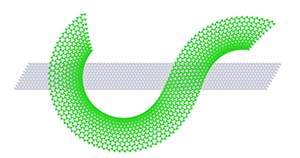
Can you crumple up two sheets of paper the exact same way? Probably not — the very flexibility that lets flexible structures from paper to biopolymers and membranes undergo many types of large deformations makes them notoriously difficult to control. Researchers from the Georgia Institute of Technology, Universiteit van Amsterdam, and Universiteit Leiden have shed new light on this fundamental challenge, demonstrating that new physical theories provide precise predictions of the deformations of certain structures, as recently published in Nature Communications.
In the paper, Michael Czajkowski and D. Zeb Rocklin from Georgia Tech, Corentin Coulais from Universiteit van Amsterdam, and Martin van Hecke of AMOLF and Universiteit Leiden approach a highly studied exotic elastic material, uncover an intuitive geometrical description of the pronounced – or nonlinear – soft deformations, and show how to activate any of these deformations on-demand with minimal inputs. This new theory reveals that a flexible mechanical structure is governed by some of the same math as electromagnetic waves, phase transitions, and even black holes.
Metamaterials rely on the use of hinges, folds, cuts, and “flexible” ingredients to display the variety of counterintuitive physics that has been steadily revealed over the past decade of intense research. Many of these new behaviors have emerged from the development of auxetics, materials that tend to shrink in all directions when they are compressed from any direction rather than bulging outward. Although the researchers’ chosen structure, “Rotating Squares,” is already one of the most heavily researched metamaterials, they uncovered entirely new and powerful physics hiding within its deformations.
“Normally complex real-world structures defy analytical physics, which made it all the more thrilling when Michael found that his conformal predictions could account for 99.9% of the variance in Corentin’s structure,” said Rocklin. “This new approach could allow us to predict and control tough, flexible structures from the size of skyscrapers to the microscale.”
The results of this paper rely on the novel observation that these maximally auxetic metamaterials deform conformally, which the researchers confirmed with a high degree of accuracy. This means that any angle drawn on the material before and after deformation will still look like the same angle. This seemingly mundane observation activates powerful mathematical structures.
For more information: Nature Communications