From MRI machines to particle accelerators and Maglev trains, superconductors have revolutionized modern technology — and they have the potential to do so much more.
“The main property of a superconducting material is that it can conduct electricity without resistance when cooled below a certain material-dependent critical temperature,” explained Binghamton University Associate Professor of Physics Elena Roxana Margine.
This amazing quality, however, comes at a cost: The most used niobium-based superconductors operate at extremely low temperatures — around 10 degrees Kelvin, equivalent to –442 degrees Fahrenheit or –263 degrees Celsius.
For the past 50 years, scientists have been searching for superconductors that can work at higher critical temperatures — ideally room temperature, although 100 degrees Kelvin (–173 degrees Celsius or –279 degrees Fahrenheit) is acceptable for a wide range of applications. Unfortunately, the high-temperature superconductors already discovered are difficult to manufacture. Copper oxide-based superconductors are ceramic compounds, for example, which are brittle and difficult to fabricate into wires, while hydrogen-based superconductors can only be synthesized under extremely high pressure — so high, in fact, that it’s like pressures found close to Earth’s core.
Margine’s work in computational physics could potentially lead to breakthroughs in this field. A $3.86 million grant from NSF’s Office of Advanced Cyberinfrastructure will help develop a comprehensive software ecosystem to model and predict advanced functional properties of materials by using many-body electronic structure methods. Margine is one of several co-principal investigators (PIs) on the grant.
The goal of this project is to expand and combine the complementary strengths of three software packages developed by the PIs of this grant and built-in compatibility layers for major density-functional theory codes, Margine explained. This cyberinfrastructure, in turn, will allow scientists to perform systematic and predictive calculations of properties that underpin the development of next-generation materials for energy, computing and quantum technologies.
Another grant from the Division of Materials Research will aid the search for superconducting materials that can operate at a higher critical temperature. The team, led by Margine and Associate Professor of Physics Alexey Kolmogorov, will explore promising combinations of boron, carbon, and various metals, using advanced modeling methods and computational tools. Kolmogorov will use a combination of evolutionary algorithms and machine learning methods to identify synthesizable compounds, while Margine will investigate the most suitable candidate materials with potential for high-temperature superconductivity.
Superconductivity is a complex process determined by the interaction between electrons and atomic vibrations in a material. Accurately modeling this interaction not only takes complex computer codes and calculations, but immense processing power. Through computational modeling, researchers may be able to predict which materials would excel as superconductors, particularly those that can operate at higher critical temperatures. Understanding how they work at the atomic level could someday lead to innovations in energy storage, medicine, electronics, transport and even quantum computing.
For more information: Binghamton University
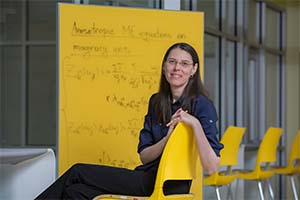
Image: Elena Roxana Margine, associate professor in the Department of Physics, Applied Physics and Astronomy at Harpur College of Arts and Sciences, photographed at the Smart Energy Building at the Innovative Technologies Complex