Scientists at the Ural Federal University (UrFU) and the Institute of Electrophysics of the Ural Branch of the Russian Academy of Sciences have developed a method for synthesizing four-component nanocomposite coatings. It is used to protect gas turbine engines, in aircraft and machine building, for metalworking, and in biomedicine. The new approach does not require high temperatures, additional equipment or materials, and allows to obtain coatings with the required characteristics. The experimental results and description of the method were published in the Membranes journal.
Nanocomposite coatings based on titanium, silicon, carbon, nitrogen are promising for use as protective wear-resistant coatings due to their unique set of properties. Today such four-component coatings are synthesized using a number of physical and chemical methods, but they have disadvantages. And scientists have proposed the method of plasma chemical decomposition, which shows the best results in obtaining the final coatings.
“Compared to the vacuum-arc method, the advantage is the absence of microdroplets that degrade the quality of the coatings. Unlike magnetron sputtering, our method provides higher deposition rates, high ion flux density necessary to form dense and high-quality coatings. If you compare it with the chemical method, the advantage is the use of environmentally and health-friendly, affordable and inexpensive components. The main advantage of the method, in our opinion, is the possibility to independently and within a wide range control almost all synthesis conditions, and, consequently, the composition and properties of the obtained coatings, which makes it possible to obtain films with the required characteristics,” says Andrey Menshakov, researcher at the UrFU and at the Ural Branch of RAS.
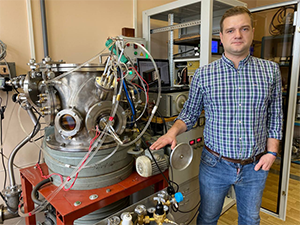
The new method is relatively easy to implement: only a gas-discharge device with a hollow cathode and an active anode is used to create a multicomponent active medium. This deposition method does not require separate facilities and ionization and filtration systems because the flow of the evaporated metal does not contain any droplets that disturb the coating structure.
The researchers note that companies, which have the necessary production technology, are now creating installations for the application of such protective coatings for various enterprises. Using the new method can improve the energy efficiency of existing facilities, as well as the quality of the resulting films. When determining specific requirements for obtaining coatings, for example, on medical products or cutting tools, it is necessary to individually select synthesis conditions that will help to obtain coatings with the necessary characteristics. Now scientists are working on this very task of synthesizing coatings with the required mechanical and physical-chemical properties.
For more information: Ural Federal University
Image: According to Andrey Menshakov, setting up an installation for synthesizing coatings using the new method is also possible at small production facilities.