In Switzerland, Antonia Neels, head of Empa’s Center for X-ray Analytics, has been working on the mysterious material called bulk metallic glasses for about 15 years. Her team investigates the internal structure of metallic glass using various x-ray methods, thereby discovering correlations with properties such as deformability or fracture behavior. In a few months, a sample of metallic glass will be studied in the microgravity of the International Space Station (ISS).
A group of researchers with Empa participation has prepared the samples and registered them with the European Space Agency (ESA) for space flight. The special alloy is supplied by the PX Group company from La Chaux-de-Fonds, which produces materials for the watch industry and dental technology.
The production of metallic glass is not entirely simple: Compared to window glass, the specially selected metal alloys must be cooled up to a hundred times faster so that the metal atoms do not form crystalline structures Only when the melt solidifies extremely quickly, it is able to form a glass. In industry, thin sheets of metallic glass are produced by pressing the melt between rapidly rotating copper drums. Researchers sometimes cast their samples in molds made of solid copper, which dissipates heat particularly well. But larger, solid workpieces made of metallic glass are not feasible using these methods.
One possible way out of the dilemma is 3D printing using a process known as powder bed process. A fine powder of the desired alloy is heated for a few milliseconds with a laser. The metal grains fuse with their neighbors to form a kind of foil. Now a thin layer of powder is placed on top, the laser fuses the freshly applied powder with the underlying foil, and thus a three-dimensional workpiece is gradually created from many briefly heated powder grains.
At Empa’s Center for X-ray Analytics, Antonia Neels’ team has already analyzed several such samples from 3D printing experiments. Meanwhile, the results always raise new questions. “Some evidence suggests that the mechanical properties of the glasses do not deteriorate, but on the contrary actually improve, if the sample contains small crystalline fractions” says Neels.
To track crystal growth in an otherwise amorphous environment, Empa experts use a variety of X-ray methods. “With radiation of different wavelengths, we can learn about the structure of the crystalline portions, but also determine close-order phenomena of the atoms in the sample – in other words, determine the properties of the chemical bonds,” Neels explains. In addition, X-ray imaging analysis, known as micro-CT, reveals details about density fluctuations in the sample. This indicates phase segregation and crystal formation.
But material samples from the 3D laser printer alone cannot completely solve the puzzle of metallic glasses. “We need to know at what temperatures these crystals form and how they grow – in order to use them to define stable manufacturing processes,” explains X-ray specialist Neels. Important information is provided by thermo-physical parameters of the melt, such as viscosity and surface tension. Experiments on the ISS offer ideal conditions for these analyses. Preliminary experiments take place in parabolic flights.
As early as 2019, the first droplets of metallic glass have floated on an experimental basis. A specially converted Airbus A310 from the company Novespace flew a zero-gravity flight with a material sample. After landing, the material sample was analyzed at Empa’s Center for X-ray Analytics.
So now a sample of the same material has been registered for a flight in the European COLUMBUS module of the ISS. The ISS-EML electromagnetic levitation furnace has been installed there since 2014. In each case, 18 material samples fly along, are automatically exchanged and can be observed by researchers on Earth via video stream. The metallic glass from Switzerland will go into space with the next batch of samples.
The researchers plan to generate a computer simulation of the melt from the far more detailed data obtained during the space flight. This will bring all the answers together in a single model through a combination of experiments on Earth and in space: At what temperature is there what viscosity and surface tension? When do crystals of what composition, size and orientation form? How does this internal material structure influences the properties of the metallic glass? From all these parameters, the researchers want to develop a manufacturing method together with the industrial partner PX Group, in order to be able to produce the coveted material in a defined form.
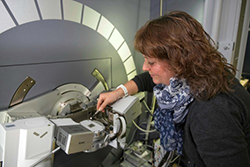
Image – Antonia Neels, head of Empa Center for X-ray Analytics, is an expert on metallic glasses and will analyze the samples from the ISS. Courtesy of Empa.
************
For more information: