Supplemental air cooling has two distinct advantages: controlling part temperature and removing overspray and fume debris from the coating surface. Clean, dry air is a must. Condensation and compressor oils are detrimental to coatings.
To spray large target areas, an ancillary air-cooling device can be attached to the spray gun or the manipulator following the gun, so a stream of compressed air blows dust and debris from the substrate surface in advance of, and following, the traversing spray stream.
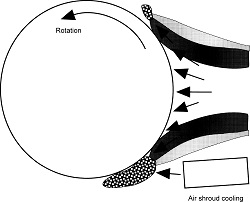
The image shows an air device positioned for spraying a large shaft. Here, debris is blown off the surface before it can be embedded into the coating. When spraying flat surfaces, air coolers should be positioned on both sides of the spray stream to help remove dust and debris.
Air coolers are usually adjusted to precede and follow the spray torch along the traverse direction. However, air cooling can be placed anywhere on the part as long as it does not interfere with the spray stream.
The type of air jet, placement, and air volume are determined by the temperature required and the potential to create and embed debris.
Cooling with air may be the most common type or source of cooling; however, other types may be used, including liquid CO2, which is very efficient, or Ar or N2 gases in specialized applications.
Image – Positioning of an air-cooling device to blow debris off the surface before it rotates into the center spray region and is incorporated into the coating.
This information is from ASM Handbooks Online, Vol. 5A: Thermal Spray Technology, Coating Structures, Properties, and Materials. To find this information (subscription required), click on the link below and scroll down to Figure 16.