Controlled relative movement of the gun with respect to the part is critical for continuous and even deposition of the coating. Critical parameters are standoff distance, surface speed, angle of impingement, and pitch or increment.
Standoff distance is the distance between the face of the gun and the part or work piece. This distance is critical because the optimal particle temperature and velocity occur in one plane along the length of the spray stream. Tolerance for standoff is a function of particle velocity. Higher-velocity processes are generally more tolerant of variation than the lower-velocity processes.
Angle of impingement has been mentioned several times in this article. Again, higher-velocity processes such as HVOF are more tolerant of off-axis spraying than low-velocity processes such as conventional flame spraying.
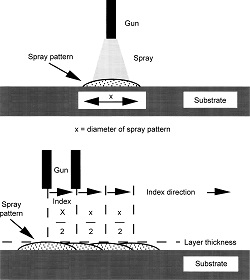
Pitch or increment, that is, the overlap between subsequent strokes of the gun/spray stream, is important to coating uniformity. Pitch is the term used for rotating elements such as rolls. As the roll turns, the gun must travel across the surface such that the pitch (thread) does not create a “barber pole” effect. The same holds true for planar surfaces, where the increment must be set and controlled to prevent striping. As a rule, lower-velocity processes that have wider spray patterns also have wider pitch/increment values. Conversely, high-velocity processes have narrower pitch/increment values. Using rules-of-thumb, pitch/increment values for HVOF and high-velocity plasma may range from 3 to 6 mm (0.13 to 0.25 in.), while flame and electric arc may be 6 to 12 mm (0.25 to 0.50 in.).
One final consideration would be the deposition rate in terms of unit thickness per pass buildup, that is, μm/pass or mils/pass. This parameter is controlled by the speed of the spray stream across the surface of the part, that is, surface speed.
Generally, the material feed rate is held constant and manipulation is sped up or slowed down to produce the required μm/pass or mils/pass. Another rule-of-thumb is that for higher-density coatings, thinner μm/pass or mils/pass layers are better; for example, plasma-sprayed alumina may be 13 μm/pass or 0.5 mil/pass. The common baseline surface speed seems to be approximately 500 mm/s (20 in./s) but varies widely about that point.
Image – How to obtain an even coating layer by indexing the torch after each pass.
This information is from ASM Handbooks Online, Vol. 5A: Thermal Spray Technology, Coating Structures, Properties, and Materials. To find this information (subscription required), click on the link below and scroll down to Figure 19.