Scientists at the U. S. Department of Energy’s Oak Ridge National Laboratory, Oak Ridge, Tenn., invented a coating that could dramatically reduce friction in common load-bearing systems with moving parts, from vehicle drive trains to wind and hydroelectric turbines. It reduces the friction of steel rubbing on steel at least a hundredfold. The novel ORNL coating could help grease a U.S. economy that each year loses more than $1 trillion to friction and wear — equivalent to 5% of the gross national product.
Researchers created a coating that imparts superlubricity to sliding parts for a study published in Materials Today Nano. “Our main achievement is we make superlubricity feasible for the most common applications,” said Jun Qu, leader of ORNL’s surface engineering and tribology group and the research study. “Before, you’d only see it in either nanoscale or specialty environments.”
Superlubricity is the property of showing virtually no resistance to sliding; its hallmark is a coefficient of friction less than 0.01. When dry metals slide past each other, the coefficient of friction is around 0.5. With an oil lubricant, the coefficient of friction falls to about 0.1. However, the ORNL coating reduced the coefficient of friction far below the cutoff for superlubricity, to as low as 0.001.
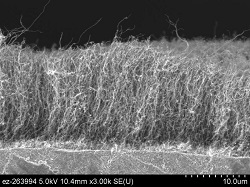
The researchers grew carbon nanotubes on steel plates and generated carbon-nanotube shavings by rubbing the plates against each other with a tribometer machine. The multiwalled carbon nanotubes coat the steel, repel corrosive moisture and function as a lubricant reservoir.
When they are first deposited, the vertically aligned carbon nanotubes stand on the surface like blades of grass. When steel parts slide past each other, they essentially “cut the grass.” Each blade is hollow but made of multiple layers of rolled graphene, an atomically thin sheet of carbon arranged in adjacent hexagons like chicken wire. The fractured carbon nanotube debris from the shaving is redeposited onto the contact surface, forming a graphene-rich tribofilm that reduces friction to nearly zero.
Making the carbon nanotubes is a multistep process. “First, we need to activate the steel surface to produce tiny structures, on the size scale of nanometers. Second, we need to provide a carbon source to grow the carbon nanotubes,” Kumara said. He heated a stainless-steel disk to form metal-oxide particles on the surface. Then he used chemical vapor deposition to introduce carbon in the form of ethanol so that metal-oxide particles can stitch carbon there, atom by atom in the form of nanotubes.
The new nanotubes do not provide superlubricity until they are damaged. “The carbon nanotubes are destroyed in the rubbing but become a new thing,” Qu said. “The key part is those fractured carbon nanotubes are pieces of graphene. Those graphene pieces are smeared and connected to the contact area, becoming what we call tribofilm, a coating formed during the process. Then both contact surfaces are covered by some graphene-rich coating. Now, when they rub each other, it’s graphene on graphene.”
The presence of even one drop of oil is crucial to achieving superlubricity. “We tried it without oil; it didn’t work,” Qu said. “The reason is, without oil, friction removes the carbon nanotubes too aggressively. Then the tribofilm cannot form nicely or survive long. It’s like an engine without oil. It smokes in a few minutes, whereas one with oil can easily run for years.”
The ORNL coating’s superior slipperiness has staying power. Superlubricity persisted in tests of more than 500,000 rubbing cycles. Kumara tested the performances for continuous sliding over three hours, then one day and later 12 days. “We still got superlubricity,” he said. “It’s stable.”
Using electron microscopy, the group examined the mowed fragments to prove that tribological wear had severed the carbon nanotubes. To independently confirm that rubbing had shortened the nanotubes, they used Raman spectroscopy, a technique that measures vibrational energy, which is related to the atomic bonding and crystal structure of a material.
“Next, we hope to partner with industry to write a joint proposal to DOE to test, mature and license the technology,” Qu said. “In a decade we’d like to see improved high-performance vehicles and power plants with less energy lost to friction and wear.”
Image – ORNL’s vertically aligned carbon nanotubes reduce friction to nearly zero to improve energy efficiency. Courtesy of: Chanaka Kumara/ORNL, U.S. Dept. of Energy.
For more information:
Oak Ridge National Laboratory