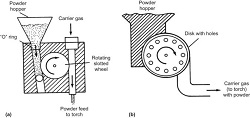
Rotating-wheel devices are powder feedstock delivery systems commonly used throughout the TS industry. The image shows a rotating wheel that delivers precise parcels of powder to the powder feed delivery tube. The wheel can be mounted either vertically or horizontally. When oriented in the vertical direction (in the geometry of the simple water wheel, as shown in the figure), the powder is dropped into the carrier gas stream. A gas tube is connected between both sides of the rotating wheel to equalize gas pressures on both sides of the wheel; otherwise, the powder would be blown off the pockets that are machined into the outside rim of the wheel.
The horizontally oriented wheel (or disk) has slots that pass over the gas delivery system. In this fashion, powder is taken out of the slots and enters the carrier gas stream.
In both cases, the powder delivery rate is controlled by the physical dimensions of the slots or pockets that hold the powder, and the rotational speed of the wheel. In either geometry, it is easy to overload the carrier gas with solids and either block the powder feed tube or cause the saltation effect by using too high a powder feed rate or an insufficient carrier gas flow rate. Of course, the dimensions of the powder feed tube and the powder injection port, as well as the pressure conditions into which the powder and carrier gas are injected, also influence the powder delivery. These powder-feeding devices may incorporate a felt seal that can become a site for contamination unless it is cleaned out and replaced for high-quality work.
Image – Powder-feeding systems: rotating-wheel system and rotating-disc system.
This information is from ASM Handbooks Online, Vol. 5A: Thermal Spray Technology, Coating Structures, Properties, and Materials. To find this information (subscription required), click on the link below and scroll down to Figure 17.
https://dl.asminternational.org/handbooks/edited-volume/12/chapter/133823/Feedstock-Material-Considerations-for-Thermal