Beijing University of Technology, China, presented the microstructure and mechanical properties of a new type of multi-component near-α titanium alloy sheet after rolling, 700°C aging, and 800°C aging in a new paper.
The results show that the strength of the alloy after aging at 700°C increases from 1156 MPa to 1304 MPa, respectively, but decreases to 1246 MPa with the aging temperature increasing. The ductility of the alloy aged at 700°C is lower than that of the rolled state, but the ductility increases slightly with the aging temperature increasing. The effect of aging heat treatment on the microstructure and precipitation behavior of alloy plates has been studied and compared with alloys before aging.
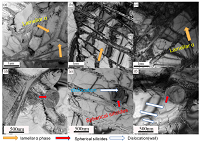
After heat treatment, the content of primary α decreases from 25% to 5%, respectively. Two kinds of silicide precipitate at different positions, with the large-size spherical silicide being (Ti, Zr, Nb)5Si3, and the small-size fusiform silicide being (Ti, Zr, Nb)6Si3, respectively. Ti3Al was precipitated in the primary α phase, during the aging process. The silicides exhibit the strengthening effect on the alloy, but the effect weakens when the silicides grow up. The loss in ductility is mainly attributed to the precipitation of the α2 phase after aging treatment. However, ductility is improved after applying higher aging temperatures as the size of the α2 phase becomes smaller, and the distribution of them tends to become dispersed.