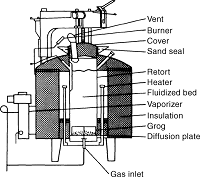
Most fluidized-bed furnaces are used at temperatures below 1095 °C (2000 °F), although some manufacturers have furnaces capable of treating components to temperatures through 1205 °C (2200 °F). Initially, the gas flows upward through the permeable base to agitate the particles as the pressure is gradually increased. (b) Eventually, the gas flow is sufficient to lift the small particles of refractory materials and to transform the particle movement into a violent turbulent motion.
In the early 1980s, this furnace technology seemed to be on the right track as an alternative to salt bath technology, showing similar advantages and applications but without the environmental hazard of salt compounds, waste disposal, recycling of salts, and so on. Nowadays it can be concluded that salt bath technology was partially substituted by vacuum technology, but especially for bainitic hardening (austempering processes), salt baths are still commonly used and show a slightly growing tendency, whereas fluidized beds are hardly used any more.
This temperature limitation is related to the wear and tear on the retort materials at high temperatures, which was one of the reasons for the reduced interest in this furnace type after the initial hype.
For more information, click on the link below (subscription required). Then scroll to Figure 8.
R Schneider; R. Mesquita; W Schützenhöfer, Distortion in Tool Steels, ASM International, 2014, https://doi.org/10.31399/asm.hb.v04d.a0005958