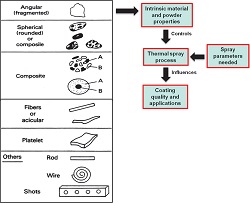
This section provides an understanding for classifying thermally sprayed coatings according to morphologies. The morphologies of feedstock materials are depicted in the image. The material morphology refers to the shape of the individual particles, and this characteristic is commonly determined via optical or scanning electron microscopy. The morphology is directly related to the TS process, as indicated in the figure, and usually the prime process variables are the TS parameters.
The particle shape is controlled by the production process. It is incorrect to assume that the powder surface is smooth or that each particle is chemically homogeneous and 100% dense. The particle shape determines the material transport from the powder hopper to the plasma torch. Thus, this characteristic is an essential quality to be determined. The particle size distribution is also an important parameter to determine, because this is optimized with regard to the coating quality.
It is generally agreed that a closely sized distribution is required to take advantage of the few optimum particle trajectories through the plasma flame to manufacture a dense coating. The ideal morphology is spherical, although needles and platelets are of research interest because they may confer special properties to the coating. The section “Particle Morphology” in this article shows the powder morphologies of some powders.
Image – Feedstock morphology.
This information is from ASM Handbooks Online, Vol. 5A: Thermal Spray Technology, Coating Structures, Properties, and Materials. To find this information (subscription required), click on the link below and scroll down to Figure 13.
https://dl.asminternational.org/handbooks/edited-volume/12/chapter/133823/Feedstock-Material-Considerations-for-Thermal