In a new study conducted by University College London researchers, ancient bricks inscribed with the names of Mesopotamian kings have yielded important insights into a mysterious anomaly in Earth’s magnetic field 3000 years ago.
The research, published in the Proceedings of the National Academy of Sciences, describes how changes in the Earth’s magnetic field imprinted on iron oxide grains within ancient clay bricks, and how scientists were able to reconstruct these changes from the names of the kings inscribed on the bricks.
The team hopes that using this “archaeomagnetism,” which looks for signatures of the Earth’s magnetic field in archaeological items, will improve the history of Earth’s magnetic field, and can help better date artifacts that they previously couldn’t.
The team analyzed the latent magnetic signature in grains of iron oxide minerals embedded in 32 clay bricks originating from archaeological sites throughout Mesopotamia, which now overlaps with modern day Iraq. The strength of the planet’s magnetic field was imprinted upon the minerals when they were first fired by the brickmakers thousands of years ago.
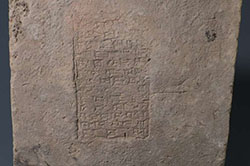
At the time they were made, each brick was inscribed with the name of the reigning king which archaeologists have dated to a range of likely timespans. Together, the imprinted name and the measured magnetic strength of the iron oxide grains offered a historical map of the changes to the strength of the Earth’s magnetic field.
The researchers were able to confirm the existence of the “Levantine Iron Age geomagnetic Anomaly,” a period when Earth’s magnetic field was unusually strong around modern Iraq between about 1050 to 550 BCE for unclear reasons. Evidence of the anomaly has been detected as far away as China, Bulgaria, and the Azores, but data from within the southern part of the Middle East itself had been sparse.
Lead author Professor Matthew Howland of Wichita State University said, “By comparing ancient artifacts to what we know about ancient conditions of the magnetic field, we can estimate the dates of any artifacts that were heated up in ancient times.”
To measure the iron oxide grains, the team carefully chipped tiny fragments from broken faces of the bricks and used a magnetometer to precisely measure the fragments.
By mapping out the changes in Earth’s magnetic field over time, this data also offers archaeologists a new tool to help date some ancient artifacts. The magnetic strength of iron oxide grains embedded within fired items can be measured and then matched up to the known strengths of Earth’s historic magnetic field. The reigns of kings lasted from years to decades, which offers better resolution than radiocarbon dating, which only pinpoints an artifact’s date to within a few hundred years.
An additional benefit of the archaeomagnetic dating of the artifacts is it can help historians more precisely pinpoint the reigns of some of the ancient kings that have been somewhat ambiguous. Though the length and order of their reigns is well known, there has been disagreement within the archaeological community about the precise years they took the throne resulting from incomplete historical records. The researchers found that their technique lined up with an understanding of the kings’ reigns known to archaeologists as the “Low Chronology.”
Image – Brick dates to the reign of Nebuchadnezzar II (ca. 604 to 562 BCE) based on the interpretation of the inscription. The object was looted from its original site before being acquired by the Slemani Museum and stored in that museum with agreement from the central government. Courtesy of the Slemani Museum.
************
For more information:
University College London