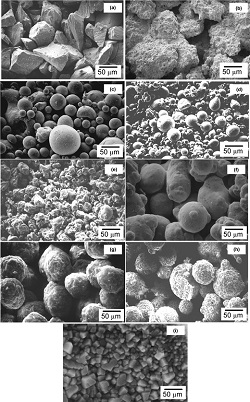
Particle morphology is not only an important part of the powder-feeding behavior but it can also be controlled. The range of particle morphologies that may be produced is shown in the image.
Particle morphology is most commonly ascertained with either scanning electron or optical microscopy. The use of the electron microscope has the additional ability of checking the chemical analysis of the material if the microscope is equipped with an analytical facility.
The shape of the particles provides an important indication of the processing methods for the material, because the surface textures of the particles have quite different characteristics, depending on the manufacturing method. These morphological features also allow the flow capability of the materials to be qualitatively ascertained. It is reasonable to assume that perfectly flowing material would be monosized and have smooth surfaces.
The spray-dried, sol-gel-manufactured composite and the agglomerated and sintered feedstock materials have characteristic globular features on the surface. The scale of these features is less than approximately 5 μm (0.2 mil); however, they do not disrupt the overall spherical nature of the individual particles, and the flow characteristics of these materials are good. The fused and crushed materials are clearly distinguished as having smooth fracture surfaces that are indicative of their manufacturing method. Their shape is not spherical and can be thought of as being irregular in shape. These powders are quite dense, and their flow characteristics are sensitive to their nonideal geometry.
The individual feedstock particles may also exhibit very fine particles (less than 1 μm, or 0.04 mil) on their surfaces. These fines are indicative of either strong ectrostatic force within the body of the powder or moisture contamination. Such particles may be symptomatic of a poor powder classification procedure (as described subsequently) and give rise to poor powder feeding. A large range of particle sizes will cause irregular deposition due to inconsistent particle trajectories.
Image – Scanning electron micrographs of various powders. (a) 250 °C (480 °F) fused and crushed yttria-stabilized zirconia (YSZ). (b) Spray-dried YSZ. (c) Plasma-fused YSZ. (d) Gas-atomized Ni-Al. (e) Water-atomized Ni-Al. (f) 5 wt% Al clad onto Ni. (g) 80 wt% Ni clad onto Al. (h) Agglomerated materials. (i) Sol-gel cobalt ferrite.
This information is from ASM Handbooks Online, Vol. 5A: Thermal Spray Technology, Coating Structures, Properties, and Materials. To find this information (subscription required), click on the link below and scroll down to Figure 14.
https://dl.asminternational.org/handbooks/edited-volume/12/chapter/133823/Feedstock-Material-Considerations-for-Thermal