Gravity-based powder-feeder systems are one of the most commonly used throughout the TS industry. Along with rotating wheel devices and fluidized-bed systems, they form the three most common. Other system types have been used in the past, find limited usage, or are still in the experimental stage.
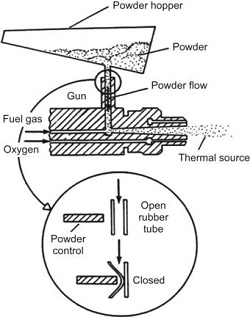
The image illustrates a gravity-based device whereby the powder falls into the TS source. Some vibratory action, normally achieved by using compressed air to drive a ball bearing around a bearing race, may be supplied to agitate the powder into the gas stream and prevent blockages. In the figure, the throttle control for the powder flow is a compressible rubber grommet that can be pinched to either allow or stop powder flowing into the carrier gas stream. This device relies on a full canister of powder so that the gravity head of material is approximately constant. There are no powder delivery tubes connecting the powder supply to the TS source.
Uneven and somewhat sporadic powder flow often occurs when the canister nears an empty condition. The powder flow rate is controlled by altering the inside diameter of the rubber grommet. This type of powder-feeding device is simple and robust but not particularly accurate or reproducible with respect to powder flow rate.
Image – Powder-feeding system: gravity- and vibration- based system.
This information is from ASM Handbooks Online, Vol. 5A: Thermal Spray Technology, Coating Structures, Properties, and Materials. To find this information (subscription required), click on the link below and scroll down to Figure 16.