UK-based Alloyed has secured £37 million in Series B funding to expand its manufacturing facilities in Abingdon, UK, and Seattle, USA, and to advance its digital alloy design platforms and product line. Founded in 2017 as an Oxford University spinout, Alloyed specializes in creating advanced, lightweight metallic alloys for additive manufacturing, with clients including Boeing, Microsoft, Anglo American plc, and BMW. Their materials are used in a variety of applications, from antennas and satellite structures to jet engine components, VR headsets, and smartwatches.
Japanese investment firm SPARX and the Development Bank of Japan led the £37M Series B round. Aviva Investors and Senningerberg-based Future Industry Ventures also provided funding. This adds to Alloyed’s existing backers, Oxford Science Enterprises, JX Advanced Metals, and Anglo American plc.
“We’re excited to welcome this exceptional group of new investors, enabling us to accelerate investment in our digital tools and expand our certified production facilities both in the UK and the US,” explained Alloyed’s CEO, Michael Holmes. “Automated design and manufacturing is an industry where the UK, with our expertise in materials science and world class engineering capability, has the potential to lead on the global stage and Alloyed is at the forefront of this transformation.”
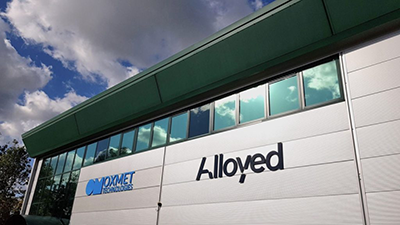
Alloyed claims that its Abingdon HQ features “one of the largest fleets of Additive Manufacturing machines in Europe.” Across its UK and US facilities, it develops advanced metallic alloys optimized for metal 3D printing. The materials developer aims to capitalize on the emerging automated design and manufacturing with its portfolio, which includes copper alloys, alloy steels, stainless steels, and aluminum alloys.
Back in 2022, Alloyed showcased its 3D printed copper cooling plate designed for high-temperature computing systems and general liquid cooling systems. This device featured a complex 3D printed lattice structure that minimizes material usage while enhancing cooling performance. The monolithic plate was reportedly simpler and more efficient at transferring heat than its conventionally manufactured counterparts.
Looking ahead, the metal developer believes high-performance alloys will play a key role in global efforts to transition to sustainable energy. It anticipates that more companies will work to deploy increasingly stronger and lighter materials to develop “next-generation technologies.”
“Additive manufacture has great promise for the energy transition and future products across a range of industries, but has been held back by a range of engineering challenges,” explained Takaki Demichi, Director and Head of Investment for SPARX Asset Management’s Next-Generation Growth Division. He believes these barriers are “directly addressed by Alloyed’s materials, processing, design, and production technologies and its highly data-driven approach.”
Development Bank of Japan’s General Manager of Innovation Promotion Office, Yuki Takemori, added, “Alloyed is at the forefront of innovation in the manufacturing sector and a natural partner for us.” The Tokyo financial institution believes its collaboration with Alloyed will “enhance the sector even further” by creating a “model case for commercialising technology.”
Additive manufacturing is attracting the attention of global investors. According to IDTechEx data, approximately $650 million was invested into 3D printing across 40 deals in 2024. While the state of investing in 3D printing has not yet reached pre-pandemic levels, it remains stable amid a shift away from tech hype to disciplined funding.
For more information: Alloyed