To determine what Earth was like early in its lifetime, researchers turn to minerals called zircons, which are resilient against physical and chemical alteration over time and thus preserve a precise chemical record about the moments in which they were formed. Some of the oldest zircon crystals are 4.4 billion years old. Now, a new study at the California Institute of Technology (Caltech) examines these most ancient zircon grains and discovers evidence for two key findings.
They discovered, first, that the early Earth underwent rapid oxidation sooner than previously believed and, second, that plate tectonics began at least 3.35 billion years ago, providing a key data point in a much-discussed debate among geoscientists.
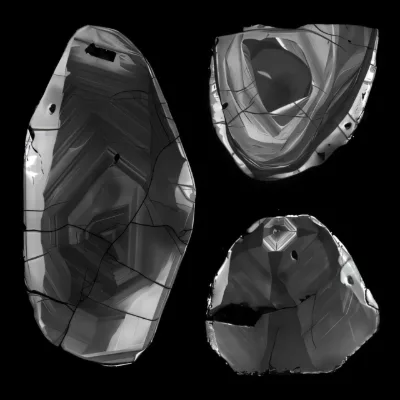
Zircon crystals are formed within hot magma and crystallize into structures that, like tree rings, reflect the conditions under which they grew. The most ancient zircon crystals, largely found in the Jack Hills region of Western Australia, provide the best record of the magma chemistry of the early Earth, extending back more than 4 billion years ago.
At some point in time, some of the rocks containing these zircon grains underwent metamorphism, and a new generation of zircon crystallized on the edges of the grains, forming distinct rims. Though the zircon crystals are only a quarter of a millimeter long, advanced analytical techniques can precisely measure trace elements (such as uranium and titanium) encapsulated in the zircon cores and rims, giving clues to the environment at the time of the mineral’s formation.
Oxidation and reduction are two opposite measures of how electrons are available to drive chemical reactions, and measuring the reduction–oxidation—or “redox”—state of a sample can be used to infer the amount of oxygen in the environment. In a geologic context, this is commonly associated with the amount of water that is present during crystallization of magma. A highly reduced environment would be very dry, whereas more oxidation may indicate more water.
The team discovered that uranium in the rims of the zircons, dating back to 4.1 billion years ago, was much more oxidized than expected. This finding indicates that if the early Earth did, in fact, start as a highly reduced environment, some event must have taken place to rapidly oxidize the planet within, at most, just a couple hundred million years after its formation.
The team also discovered that the zircon crystals must have experienced both a high-pressure and relatively low-temperature environment after forming. This environment is suggestive of a subduction zone, indicating that a large fragment of crust carried these zircons from the surface deep into the planet where it experienced high pressures.
The findings suggest that plate tectonics may have been active at least 3.35 billion years ago. Plate tectonics provide the dynamic energetic environment necessary for the evolution of life, and there has been much debate among scientists about when the process began. This new study provides a crucial new data point from early Earth.
This study is the first application of a technique called U XANES oxybarometry (x-ray absorption near edge structure) to determine the redox state of early Earth, specifically by examining uranium oxidation states in ancient zircon crystals. To do this, the team collaborated with researchers at the Advanced Photon Source at Argonne National Laboratory to utilize their synchrotron facilities.
A paper describing the research appears in the journal Proceedings of the National Academy of Sciences.
Image – A zircon crystal exhibiting distinct edges, or rims, from a metamorphic event after its initial formation. Courtesy of Shane K. Houchi/Caltech.
************
For more information:
California Institute of Technology