Researchers from Lawrence Livermore National Laboratory (LLNL), Calif., created a new model for crystal defects at realistic temperatures. As most materials, especially metals and ceramics, are crystals, their atoms are arranged in three-dimensional lattices that repeat the same exact pattern, over and over again. But there’s a well-known saying in materials science: “Crystals are like people. It is the defects that tend to make them interesting.”
In the new LLNL model, the simulation technique overcomes long-standing challenges in the field of calculating material structure and properties that were previously impossible to obtain. The result gives promise for improved production and performance of materials.
Their work focused on two types of defects: point defects and grain boundaries.
“Cracks often find it easier to grow along grain boundaries, which can cause materials to fracture,” said author and LLNL postdoctoral researcher Flynn Walsh. “This is just one example of how defects affect the properties of materials ranging from protective walls in fusion energy plants to the magnets that power most electric motors.”
To improve technology based on these materials, researchers need to understand what’s happening to the crystal structure in complex defects like grain boundaries. While it is technically possible to image these defects, the associated experiments are very difficult. Modeling therefore, is critical.
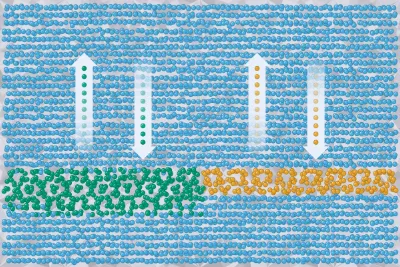
The new simulation technique advances the field with a simple but powerful idea: It allows atoms the freedom to come and go from the simulation. In a real-world defect, nature adjusts by moving atoms around until it finds a stable state. The team aimed to replicate that phenomenon.
“The conventional way to perform these simulations is to directly add and remove atoms, but this doesn’t work in solid crystals because the energy barriers are too high,” said Walsh. “Our approach is instead based on gradually adding and removing atoms. The basic idea is simple but doing it efficiently and correctly was surprisingly difficult.”
Instead of abruptly shoving an atom through a packed crowd of its fellows, the model softly pushes or pulls it into place.
This new technique opens the door, for the first time, to predicting grain boundary structures and phase transitions at finite temperatures,” said Timofey Frolov, LLNL scientist and principal investigator on the project. “This enables more accurate modeling of materials used in extreme environments such as fusion reactors.”
The team’s research was published in Physical Review Letters (“Monte Carlo Simulations of Crystal Defects in Open Ensembles”).
Image – A grain boundary defect with two phases (green and orange) in a tungsten crystal (blue) at 1848 degrees Kelvin. A new model gradually adds and removes atoms to calculate material structure and properties that were previously impossible to obtain. Courtesy of Dan Herchek/LLNL.
************
For more information:
Lawrence Livermore National Laboratory