Researchers at The University of Osaka, Japan, have developed an outdoor wireless EEG transmission system using energy harvested from the temperature difference between the human body and surrounding air, even under hot summer conditions.
Continue readingResearchers develop 3D imaging method for mapping electrical behavior in perovskite films
Researchers at several Chinese institutions, led by the Chinese Academy of Sciences, have developed a 3D electrical imaging technique that enables direct observation of how charge moves through perovskite films.
Continue readingAnalysis of 6,276 connectors for rooftop PV systems
Sandia National Labs researchers have created a new dataset on the rates and types of rooftop photovoltaic connector failures and published the first large-scale investigation of harvested PV connectors, drawing from a dataset of 6276 connectors from residential rooftop solar systems across the United States.
Continue reading$11.5 million sponsorship creates new research institute
Epsilon Group, India, a leading innovator in carbon black and advanced battery materials for electric vehicles and energy storage, is partnering with Tufts University in Massachusetts to launch the Tufts Epsilon Materials Institute-a new research center made possible by an $11.5 million sponsorship and dedicated to advancing materials science and engineering for global energy and sustainability solutions.
Continue readingEarthquake prediction techniques provide quick insight into material failure analysis
Researchers from the University of Illinois Urbana-Champaign, in collaboration with Sandia National Laboratories and Bucknell University, have found that insight from muscovite mica and earthquake statistics can help quantify how hostile environmental interactions impact the degradation of materials used in advanced solar panels, geological carbon sequestration, and infrastructure.
Continue readingPenspen strengthens Latin American presence with new strategic base in Peru
Penspen, United Kingdom, a leading global energy consultancy, has opened a new strategic base in Peru following significant growth in the Latin American region.
Continue readingSemiconductors are revolutionizing solar power
New research at the University of Kansas partially explains the exceptional performance of a new class of organic semiconductors called non-fullerene acceptors.
Continue readingTOPCon modules endure ‘significant degradation’ in damp heat testing compared to PERC
Scientists from the University of New South Wales published a report into passivated emitter and rear contact (PERC) and tunnel oxide passivated contact (TOPCon) solar modules, finding that the latter has endured “significant degradation” in damp heat testing.
Continue readingInvisible armor for steel: how hBN coating is reinventing metal durability
Researchers at Oak Ridge National Laboratory, Oak Ridge, Tenn., demonstrated that stainless steel and other metal alloys coated with hexagonal boron nitride, or hBN, exhibit non-stick or low-friction qualities along with improved long-term protection against harsh corrosion and high-temperature oxidation in air.
Continue readingStanford University sends semiconductor investigation to the International Space Station
Researchers from Stanford University, Palo Alto, Calif., sent an investigation to the space station to leverage microgravity to improve the synthesis of materials for photovoltaic devices designed to convert sunlight into electricity for solar energy applications.
Continue readingProcessing of nano-reinforced aluminum hybrid metal matrix composites and the effect of post-heat treatment: a review
A review from the School of Engineering and Technology, India, describes the increasing demand for cutting-edge materials with a high strength-to-weight ratio and economic considerations. Lightweight materials such as aluminum (Al) and its alloys are attractive, but some properties such as low thermal stability and high wear rate limit the application of aluminum alloys (AA) to some extent. Many researchers have developed various composites to get around these restrictions and increase the performance of aluminum and its alloy. Metal matrix composites (MMCs) with nanoparticles have revealed greater mechanical and tribological properties compared with micron-sized reinforcements. This review summarizes the latest developments in this field.
Onsemi opens state-of-the-art systems application lab for electric vehicles in Europe
Onsemi, Scottsdale, Ariz., opened an application test lab in Piestany, Slovakia, focused on the advancement of system solutions for battery/plug-in hybrid/electric vehicles and energy infrastructure power conversion systems.
Continue readingAI breakthrough could help us build solar panels out of ‘miracle material’, scientists say
Artificial intelligence is helping engineers build solar panels out of a “miracle material”.
Scientists have long been excited about the possibility of new perovskite tandem solar cells, which could help bring the vastly improved efficiency of perovskite to mass production. They have an efficiency of more than 33 percent, dramatically higher than conventional silicon solar cells.
Those tandem solar cells come with a host of other benefits, too. They rely on inexpensive raw materials and can be made relatively easily.
Engineers have faced a problem, however, in making them cheaply and at scale. To make them efficient, manufacturers need to make a very thin, high-grade layer of perovskite.
Doing that is difficult. It relies on a complex process that varies significantly, seemingly with little explanation.
Trying to improve that process has often relied on a gradual process of trying out new possibilities through trial and error.
Now scientists have successfully built a new system that uses artificial intelligence to try and work out how to build those layers better. Instead of picking through video recordings to work out how different layers work, researchers were able to train a computer system to spot the hidden signs of good and bad coatings.
After the system was built, it was able to be used to better understand how to change the production to make it more efficient, researchers said.
“These are extremely exciting results,” said Ulrich W Paetzold, a researcher from the Karlsruhe Institute of Technology, who worked on the new study. “Thanks to the combined use of AI, we have a solid clue and know which parameters need to be changed in the first place to improve production.
“Now we are able to conduct our experiments in a more targeted way and are no longer forced to look blindfolded for the needle in a haystack. This is a blueprint for follow-up research that also applies to many other aspects of energy research and materials science.”
For more information: Advanced Materials
One Minute Mentor: Plasma Nitriding Equipment
Cold-walled (double-walled water-cooled) systems were the first generation of plasma nitriding furnaces. This technology is also a vacuum-based process but employs the principle of glow discharge to provide energy for heating and nitriding at one time. Therefore, the independent control of the temperature stability and the nitriding intensity is not possible because both processes are using the same energy source—the plasma.
The hot-wall plasma nitriding furnaces, the next generation of cold-wall ion nitriding systems, are mainly used and built now. This system ensures optimal nitriding quality by fulfilling the highest demands on temperature and nitriding process control. The big advantage of this technology is the separation of the control of the heating and the plasma nitriding parameters. The heating and temperature control of hot-wall plasma nitriding furnaces is realized by several independent heating/cooling zones, which guarantees optimal temperature homogeneity
For more information, click on the link below (subscription required). Then scroll to Figure 26.
R Schneider; R. Mesquita; H. Altena; T. Müller; P. Seemann, Processes and Furnace Equipment for Heat Treating of Tool Steels, ASM International, 2014, https://doi.org/10.31399/asm.hb.v04d.a0005958
$18M to advance materials research for quantum computing, sustainable plastics and more
More efficient computing—potentially room temperature quantum computing—and recyclable rigid plastics are two projects to be undertaken by a new materials research science and engineering center at the University of Michigan.
Continue readingQMD precision components business now part of Cirtec Medical
Cirtec Medical Corp., Lowell, Mass., has acquired QMD Precision Components, a business that specializes in the development and manufacturing of silicone, polyisoprene, and other custom elastomeric components, tubing, and subassemblies.
Cirtec is a strategic outsourcing partner of complex medical devices, including minimally invasive and active implantable devices. The acquisition will enable Cirtec to provide customers with advanced expertise in medical silicone molding and extrusion. The integration of Precision Components within the Cirtec brand will offer comprehensive, integrated solutions based on decades of silicone experience. The acquisition will also strengthen Cirtec’s platform for growth in existing markets such as active implantables, interventional, and minimally invasive surgical devices. Precision Components consists of Centers of Excellence in Sturtevant, Wisconsin, and Rock Hill, South Carolina, and engineering and manufacturing capabilities will remain at the facilities, along with current leadership.
Perovskites, a ‘dirt cheap’ alternative to silicon, just got a lot more efficient
A study at the University of Rochester, Rochester, N.Y., suggests perovskites — a family of materials nicknamed for their crystalline structure that have shown extraordinary promise in recent years as a far less expensive, equally efficient replacement for silicon in solar cells and detectors — may become far more efficient.
Researchers typically synthesize perovskites in a wet lab, and then apply the material as a film on a glass substrate and explore various applications. Chunlei Guo, professor of optics at the University of Rochester leading the study reported in Nature Photonics, instead proposes a novel, physics-based approach.
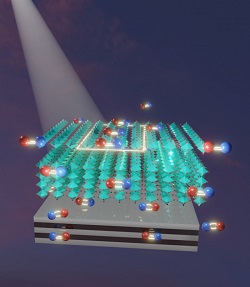
By using a substrate of either a layer of metal or alternating layers of metal and dielectric material—rather than glass—he and his coauthors found they could increase the perovskite’s light conversion efficiency by 250 percent.
“No one else has come to this observation in perovskites,” Guo says. “All of a sudden, we can put a metal platform under a perovskite, utterly changing the interaction of the electrons within the perovskite. Thus, we use a physical method to engineer that interaction.”
Metals are probably the simplest materials in nature, but they can be made to acquire complex functions. The Guo Lab has extensive experience in this direction. The lab has pioneered a range of technologies transforming simple metals to pitch black, superhydrophilic (water-attracting), or superhydrophobic (water-repellent). The enhanced metals have been used for solar energy absorption and water purification in their recent studies.
In this new paper, instead of presenting a way to enhance the metal itself, the Guo Lab demonstrates how to use the metal to enhance the efficiency of pervoskites.
“A piece of metal can do just as much work as complex chemical engineering in a wet lab,” says Guo, adding that the new research may be particularly useful for future solar energy harvesting.”
In a solar cell, photons from sunlight need to interact with and excite electrons, causing the electrons to leave their atomic cores and generating an electrical current, Guo explains. Ideally, the solar cell would use materials that are weak to pull the excited electrons back to the atomic cores and stop the electrical current.
Guo’s lab demonstrated that such recombination could be substantially prevented by combining a perovskite material with either a layer of metal or a metamaterial substrate consisting of alternating layers of silver, a noble metal, and aluminum oxide, a dielectric.
The result was a significant reduction of electron recombination through “a lot of surprising physics,” Guo says. In effect, the metal layer serves as a mirror, which creates reversed images of electron-hole pairs, weakening the ability of the electrons to recombine with the holes.
The lab was able to use a simple detector to observe the resulting 250 percent increase in efficiency of light conversion.
Several challenges must be resolved before perovskites become practical for applications, especially their tendency to degrade relatively quickly. Currently, researchers are racing to find new, more stable perovskite materials.
“As new perovskites emerge, we can then use our physics-based method to further enhance their performance,” Guo says.
Image – This illustration from the Guo Lab shows the interaction between a perovskite material (cyan) and a substrate of metal-dielectric material. The red and blue pairings are electron-hole pairs. Mirror images reflected from the substrate reduce the ability of excited electrons in the perovskite to recombine with their atomic cores, increasing the efficiency of the perovskite to harvest solar light. Courtesy of: Chloe Zhang.
For more information:
University of Rochester



