Amatanweze confirms new methods to reduce steel defects

When producing ultra-strong steel parts for vehicles, military gear, and heavy manufacturing, even minor cracks or distortions during heat treatment can cause significant delays and material waste. Dr. Kingsley Amatanweze, a recent Ph.D. graduate from the Missouri University of Science and Technology, has developed new methods to reduce these costly issues by improving the induction melting, pouring, and cooling processes of steel.

Continue reading

From roots to rugged circuits: Tree-inspired printing tech for flexible electronics

Researchers at Xi’an Jiaotong University, China, have developed a new Template-Constrained Additive printing technology inspired by tree root systems that enhances the mechanical robustness and precision of flexible electronic circuits, allowing them to withstand extreme conditions like high temperatures and mechanical wear, expanding their applications in smart robotics and advanced sensing systems.

Continue reading

Metal with nanoscale voids is mechanically superior to void-free samples

A research team led by Prof. JIN Haijun from the Institute of Metal Research (IMR) of the Chinese Academy of Sciences, recently proposed a radical new way to view voids that counters the traditional perspective that fatal flaws must be eliminated in manufacturing. They suggest that the presence of voids is not always hazardous. Instead, voids can be beneficial if they are added “properly” in the material.

Continue reading

Tin toughens bioimplant titanium alloys through cocktail effect

Beta (β)-type titanium (Ti) alloys are renowned for their strength, formability, and resistance to harsh environments, making them ideal for implants and prosthetics. However, under certain conditions, a brittle omega phase can form, making the material prone to breaking. While it is known that adding tin (Sn) negates this, and makes β-type Ti alloys stronger, the exact mechanics behind this continued to puzzle scientists. That is until researchers recently discovered a metallurgical cocktail effect to explain it.

Continue reading

LLNL scientists advance light-responsive material

Researchers at Lawrence Livermore National Laboratory, Livermore, Calif., have furthered a new type of soft material that can change shape in response to light, a discovery that could advance “soft machines” for a variety of fields, from robotics to medicine.

Continue reading

Ancient graphite reveals a quantum surprise

Scientists at The University of Manchester’s National Graphene Institute have discovered new physics in graphite through the application of twistronics, revealing a 2.5-dimensional mixing of surface and bulk states. The research opens new possibilities in controlling electronic properties in both 2D and 3D materials.

Continue reading

Stunning discovery: metals can heal themselves

For the first time, scientists at Sandia National Laboratories, Albuquerque, N.M. and Texas A&M University, have witnessed pieces of metal crack, then fuse back together without any human intervention, overturning fundamental scientific theories in the process.

Continue reading

Nanoindentation testing results found inconsistent

Nanoindentation testing is a high-precision indentation test technique that has advantages for nondestructive testing. However, researchers found that when testing the same sample with different Berkovich indenters, inconsistency still arises even if the indenters are regularly calibrated. This inconsistency poses challenges in accurately testing material hardness and comparing data from different laboratories.

Continue reading

Spray Tips: Mechanical methods for producing thermal spray powders

The purposes of milling are many: to reduce the size of particles or agglomerates, to eliminate particle segregation or preferred orientation in single-phase particles or in multicomponent powder systems, and to homogeneously disperse the many components.

Three basic stages are followed during the milling process: an initial rapid reduction in the size of aggregates, fracture of individual particles, and eventually, reagglomeration of fine particles after extended milling. The initial aggregates may be approximately 10 to 15 μm (0.4 to 0.6 mil), and these will be reduced to fines of the order of 0.1 μm (0.004 mil).

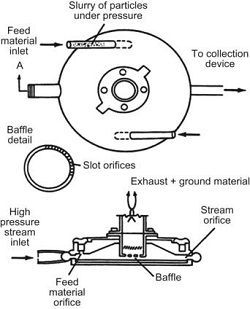
The problems of mill wear have been partially overcome with fluid energy and shear mills. The operating principle of these devices is similar. The material is incorporated into either a gas or a liquid stream, and two streams of the fluidized material are forced to be coincident. The individual particles collide and abrade each other. The grinding efficiency of these mills is high and there is minimum contamination, because there is little high-velocity contact with the walls of the mill. The major problem with this type of mill is the necessity to separate a fine particle from the fluidizing gas or liquid. The required filtering system adds to the complexity of the milling operation.


Image – Fluid energy mill.

This information is from ASM Handbooks Online, Vol. 5A: Thermal Spray Technology, Coating Structures, Properties, and Materials. To find this information (subscription required), click on the link below and scroll down to Figure 2.
https://dl.asminternational.org/handbooks/edited-volume/12/chapter/133823/Feedstock-Material-Considerations-for-Thermal

