 The purposes of milling are many: to reduce the size of particles or agglomerates, to eliminate particle segregation or preferred orientation in single-phase particles or in multicomponent powder systems, and to homogeneously disperse the many components.
Three basic stages are followed during the milling process: an initial rapid reduction in the size of aggregates, fracture of individual particles, and eventually, reagglomeration of fine particles after extended milling. The initial aggregates may be approximately 10 to 15 μm (0.4 to 0.6 mil), and these will be reduced to fines of the order of 0.1 μm (0.004 mil).
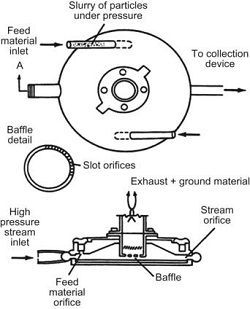
The problems of mill wear have been partially overcome with fluid energy and shear mills. The operating principle of these devices is similar. The material is incorporated into either a gas or a liquid stream, and two streams of the fluidized material are forced to be coincident. The individual particles collide and abrade each other. The grinding efficiency of these mills is high and there is minimum contamination, because there is little high-velocity contact with the walls of the mill. The major problem with this type of mill is the necessity to separate a fine particle from the fluidizing gas or liquid. The required filtering system adds to the complexity of the milling operation.
Image – Fluid energy mill.
This information is from ASM Handbooks Online, Vol. 5A: Thermal Spray Technology, Coating Structures, Properties, and Materials. To find this information (subscription required), click on the link below and scroll down to Figure 2.
https://dl.asminternational.org/handbooks/edited-volume/12/chapter/133823/Feedstock-Material-Considerations-for-Thermal