


Skip to content

Exponent team receives DOE funds to advance EV battery technology

The DOE awarded $42 million in funding for 12 projects developing next-generation electric vehicle battery technologies to Exponent, Inc., Menlo Park, Calif., along with colleagues from the National Renewable Energy Laboratory (NREL) and the University of Texas, Austin. Project funding comes from the Department of Energy’s Electric Vehicles for American Low-Carbon Living (EVs4ALL) program.

“Exponent has been a leader in evaluating battery performance, risk, and safety for our clients for over 20 years,” said Ryan Spray, Ph.D., principal scientist at Exponent. “We look forward to the opportunity, with NREL and UT, to apply our deep expertise toward evaluating the energy storage technologies of tomorrow to enable new transportation possibilities.”

Deploying “clean” (zero emission) EVs is key to global decarbonization efforts. In the U.S., for instance, EVs4ALL reports that 80% adoption of EVs could reduce overall CO2 emissions by 800 million tons per year. However, the widespread adoption of EVs depends on developing more durable, faster-charging battery technologies that are effective at low temperatures.

Exponent’s team will focus on characterizing the risks posed by next-generation cells from fundamental reaction-kinetics of the materials all the way to the battery pack level. The project will lead the charge by investigating failure modes and effects, revising testing standards, and new capabilities and tools to help de-risk adoption of next-generation cells for commercial applications.


For more information:

Exponent, Inc.
https://www.exponent.com

Award winning adaptive measurement templates speed up identification of deformed components

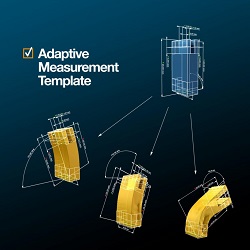
Leading software provider Volume Graphics, Germany, received a 2023 industry award for their Adaptive Measurement Template application that automatically compares original CAD intent against scan-based visualizations of parts, made with almost any material or manufacturing method, to assess quality and robustness. Volume Graphics’ Adaptive Measurement Templates has been named as one of the ten most innovative technologies for 2023 by a leading industry publication.

As CT scanning of parts becomes an increasingly routine quality-inspection step for manufacturers in automotive, aerospace, energy, medicine and other industries, the software that interprets that CT-scan data is becoming ever-more sophisticated, as well as more user-friendly.

An independent jury of machine-vision experts anonymously evaluated a shortlist of technology developments in image processing, metrology, embedded vision, and AI. The editorial team drew up the original list from around 30 products that stood out at trade fairs or in news articles over the past year. The jury then assigned points and selected the ten technologies with the highest total to be listed as Top Innovations. Products or solutions are selected because they enable more accurate, better, or simpler inspections for the industry.

Volume Graphics provides its Adaptive Measurement Templates in its latest versions of VGSTUDIO MAX, VGSTUDIO, VGMETROLOGY and VGinLINE software. These applications use data from CT-scanned objects to inspect and evaluate product quality. The shape-following templates speed up the identification of deformed components by allowing users to digitally apply metrics from their original CAD data or Product Manufacturing Information onto digital visualizations of the altered components, created from the CT scans.

The templates then highlight any differences between the original design and the as-manufactured-and-scanned part, and can be further applied to determine if such deviations are significant enough to affect performance or even cause rejection of the part.

This is highly valuable for the inspection of injection-molded parts and 3D-printed parts, which can often be out of tolerance and/or warped in such a way that a standard measurement plan, created on the nominal CAD object, cannot be applied easily or automatically to them. In such cases, correct analysis used to be possible only by applying time-consuming, local coordinate systems. The new Adaptive Measurement Templates apply dimensions and tolerances much more quickly, even to severely distorted parts, and can also inform design changes that improve final product quality.


For more information:

Volume Graphics

www.volumegraphics.com